
CQRS as used here
Summary. Command Query Responsibility Segregation separates the code that changes state from the code that answers questions. This kit applies the light form: every use case is either a command or a query, each with one handler, reached through a command bus or a query bus. A command goes through the aggregate and returns at most an identifier; a query never changes state and may read a projection through a port without loading aggregates. Aggregates keep their state in tables unless one is chosen to be event-sourced, and there is no second database by default. This page says what that buys, what it does not, and when the split is not worth having.
From a method rule to an architecture rule
Section titled “From a method rule to an architecture rule”Bertrand Meyer's command-query separation is a rule about methods: a method either changes state or returns a value, not both. Greg Young and Udi Dahan lifted it to the level of the model: use one model to write and another to read, because the two have different shapes and different loads. Fowler's summary and warning is the usual reference: the split helps in a minority of complex domains and adds risk elsewhere.
The kit takes the part that costs little and pays in every project:
| Element | Rule in this kit |
|---|---|
| a use case | one command or one query, in its own folder, with one handler |
| a command | changes state through one aggregate; returns nothing or an identifier |
| a query | changes nothing; returns a view shaped for the caller |
| the way in | CommandBus and QueryBus, never a handler class |
| what is common to all use cases | a bus middleware, not code repeated in handlers |
The normative text is ARCHITECTURE.md section 4 ("Use cases", "Buses");
the shape of a handler is application/handler-shape, and a query that saves, deletes or
publishes is reported by application/command-query-separation.
The two paths, on the scheduling application
Section titled “The two paths, on the scheduling application”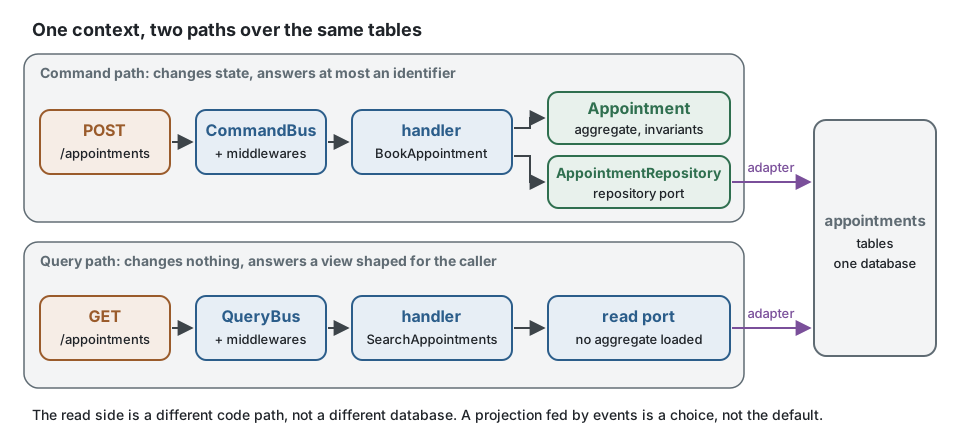
Command. BookAppointment carries the actor and the requested slot. The handler loads what
it needs, calls one intention method (Appointment.book(...)), saves through the repository
port and does nothing else: the save hands the recorded events over, and the unit of work
dispatches them once the handler has returned, before the commit. It answers the identifier of
the new appointment and nothing else: the client that wants to display the appointment sends
GetAppointment. Returning the whole aggregate would tie the response to the write model.
Query. SearchAppointments needs twenty rows of five columns, filtered by what the actor may
see and paginated. Loading twenty aggregates with their invariants to throw most of the state
away is waste. The handler asks a read port, whose adapter queries the tables directly and
returns the shape the port declares. The access scope computed by the authorizer goes into that
query, so nothing is filtered in memory after loading (see
Authentication and authorization).
Both paths read the same tables. The read side is a different code path, not a different database.
The query path in code
Section titled “The query path in code”A query names its answer in its type, a read port declares the shape the caller needs, and the handler asks the port. The bus infers the answer from the query, so the route gets a typed result without knowing the handler:
import { definePermissions } from '@ddd-ts-kit/auth';import { AuthorizedQuery, InMemoryQueryBus, type Actor, type BusMiddleware, type Logger } from '@ddd-ts-kit/kernel';import { QueryHandler, Requires } from '@ddd-ts-kit/kernel/declarations';
const appointmentsPermissions = definePermissions('appointments', {  'appointment.search': { description: 'Search the appointments of a practitioner' },});
// application/ports/appointment-lines.port.ts: the shape the screen needs, not the aggregateexport interface AppointmentLine {  readonly id: string;  readonly startsAt: string;  readonly clientName: string;}
export abstract class AppointmentLines {  abstract ofPractitioner(practitionerId: string, limit: number): Promise<readonly AppointmentLine[]>;}
// application/queries/search-appointments/search-appointments.query.ts@Requires(appointmentsPermissions['appointment.search'])export class SearchAppointments extends AuthorizedQuery<readonly AppointmentLine[]> {  constructor(    actor: Actor,    readonly practitionerId: string,  ) {    super(actor);  }}
// application/queries/search-appointments/search-appointments.handler.ts: reads, never saves@QueryHandler(SearchAppointments)export class SearchAppointmentsHandler implements QueryHandler<SearchAppointments> {  constructor(private readonly lines: AppointmentLines) {}
  execute(query: SearchAppointments): Promise<readonly AppointmentLine[]> {    return this.lines.ofPractitioner(query.practitionerId, 20);  }}
// platform/buses/: what every query goes through, written once for all of themdeclare const logger: Logger;declare const lines: AppointmentLines; // the adapter the platform binds to the port
const logged: BusMiddleware = async (message, next, info) => {  logger.info('use case', { kind: info.kind, name: info.name });
  return next();};
const queryBus = new InMemoryQueryBus()  .use(logged)  .register(SearchAppointments, new SearchAppointmentsHandler(lines), { context: 'appointments' });
// presentation/: the route knows the bus and the query, never the handlerexport async function appointmentsOf(actor: Actor, practitionerId: string): Promise<readonly AppointmentLine[]> {  return queryBus.execute(new SearchAppointments(actor, practitionerId));}
In a generated project the buses are built in src/platform/buses/. In the declared style the
handlers are registered from their declarations; in the explicit style the module of the
context calls register for each one, as the sample does to show what the bus holds (see
Ports and composition).
Two habits the rules hold
Section titled “Two habits the rules hold”Instead of a command that hands the aggregate back to the caller:
export class BookAppointment extends AuthorizedCommand<Appointment> { /* ... */ }// the route serialises the aggregate: the response is now tied to the write modelwrite a command that answers its identifier, and a query for what the client displays:
export class BookAppointment extends AuthorizedCommand<string> { /* ... */ }const id = await commandBus.execute(new BookAppointment(actor, calendarId, startsAt));const appointment = await queryBus.execute(new GetAppointment(actor, id));Instead of a query that changes state on the way:
async execute(query: GetAppointment): Promise<AppointmentView> { const appointment = await this.appointments.findById(query.appointmentId); appointment.markSeenBy(query.actor.id); await this.appointments.save(appointment); // application/command-query-separation return toView(appointment);}write the change as a command of its own (MarkAppointmentSeen), sent by the caller that
wants it, and keep the query a pure read.
Why buses
Section titled “Why buses”A route could call a handler directly. The buses exist for three reasons:
-
One place for what every use case needs. The generated platform (
src/platform/buses/) puts on the buses, as middlewares and outermost first: the report of an unexpected failure (when the stack has an error tracker), the log entry, the measure, the permission check, the span of the use case, the staging of an uploaded file and the wake-up of the outbox relay (commands only, when the stack has them), the audit entry (when the audit trail is on) and, for commands, the unit of work. A handler contains none of it, so none of it can be forgotten in a new handler.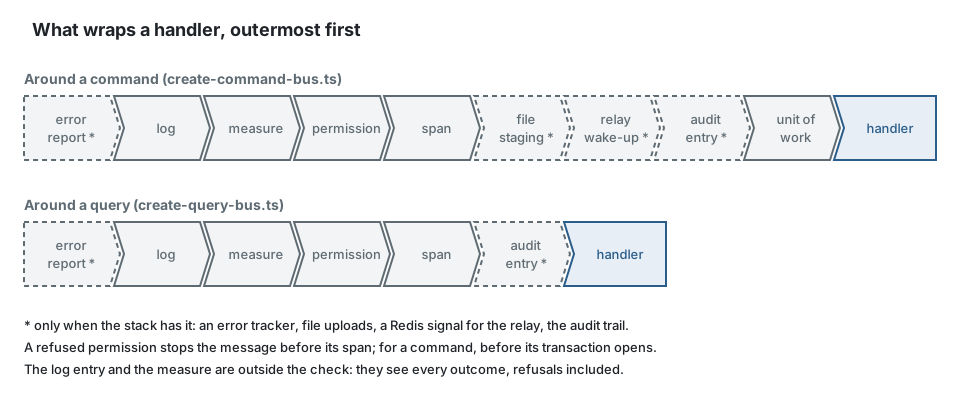
-
One way in for every caller. A route, an integration event handler and a scheduled job all send a command. The use case is authorized, audited and run in a transaction the same way whoever started it.
-
A seam. The buses are ports of the kernel with in-process implementations. Another transport is an adapter chosen in the composition root; the callers do not change.
The price is one level of indirection: "go to definition" on execute lands on the bus, not on
the handler. The handler lives next to its command, in the same folder, which is how it is
found.
What it buys
Section titled “What it buys”- Use cases are visible. The list of commands and queries of a context is its functional
surface:
ddd-ts-kit describe <context>prints it, and a permission is declared on each (authz/declared). - Reads stop bending the model. An aggregate is sized for its invariants (see Aggregates), not for the screens that display it. A new column in a list is a change of a read adapter.
- Each side is tested the way it deserves: behaviour for commands, the returned shape for queries.
- Commands are easy to make idempotent and to audit: they are named data, sent through one place.
- The door to a separate read store stays open. A read port can later be served by a
projection fed by events, as
availabilityis, without touching the callers.
What it does not buy, and what the kit does not do
Section titled “What it does not buy, and what the kit does not do”- Event sourcing is a choice per aggregate, not part of CQRS. Aggregates are stored as state by default, and their domain events are recorded to be dispatched at the end of the unit of work, not to rebuild them. CQRS and event sourcing are independent patterns that are often presented together: one aggregate whose history is the business can be event-sourced while the others keep their rows (Event sourcing, per aggregate).
- No separate read database. A projection is a table of the
consuming context. The runtime packages carry the read side:
Criteria(filters, sort and page of a list, checked against a definition), hydration, theReadModelStoreport with a SQL table store, the@Projectionand@Ondeclarations of a projector and a rebuild (kernel README, "Criteria", "Hydration" and "Projections"). The CLI generates part of it:generate query --searchwrites a read port with an in-memory adapter and a fake, andgenerate projection <context> <Name> <event-type>writes a projector and its spec, in the both styles (in the explicit style on tsyringe the module file of the context includes it withbuilder.include(<Name>Projection); on a platform wired by hand the class is plain and the module subscribes it under its consumer name), andgenerate read-model <context> <Name> --field <name>:<type>...writes the read model it keeps: the port overReadModelStorewith the type of its row and its criteria, the table in the schema of the context, the store adapter of the ORM of the project bound to the port, the fake, and a spec that runsreadModelContracton both. The columns of the fields accept null, since a removed row is a trace that keeps its key and its stamp alone (what a deleted row leaves), and a check constraint,<table>_live_rows_whole, keeps every other row whole (on Prisma, whose schema language has none, the statement is left to add to the migration); a text column a read sorts or compares by range takes the collation"C"in its migration, criteria ordering strings by code point. The status of each part is in the read side proposal. - No performance by itself. Two code paths over one database scale like one database.
- No asynchronous commands by default. The in-process buses are awaited. A command answered "accepted" and processed later is a design the project builds on events.
When a projection is the right read model
Section titled “When a projection is the right read model”availability answers FindOpenSlots. The answer combines the working hours and time off held
by calendars with the appointments held by appointments. Asking both contexts at each search
would couple three contexts at run time. Instead availability keeps its own table of open
slots, updated when calendars.calendar.working-hours-changed,
appointments.appointment.booked or appointments.appointment.cancelled arrive. The search is
one local query. The cost is that the answer can be a moment late: a slot shown as open may have
been taken a second ago, and appointments is what refuses the double booking (see
Eventual consistency).
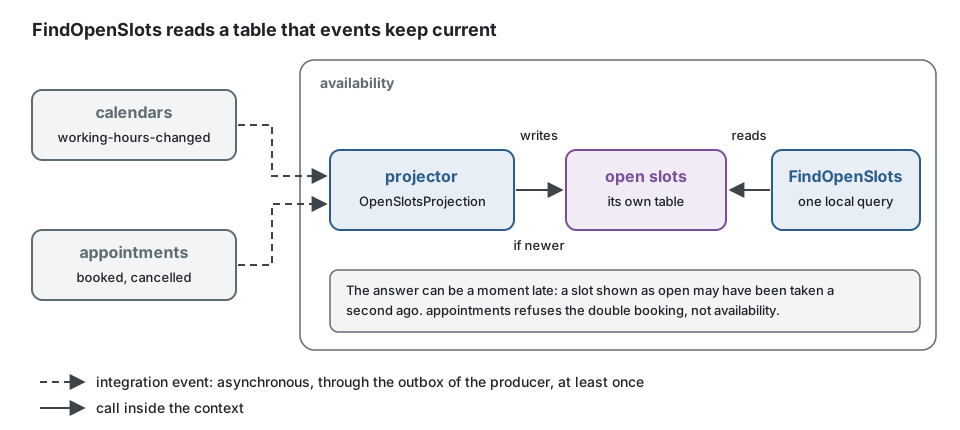
The projector applies each event to one row, and its store writes only when the event is newer than the one the row holds, so a redelivery or a late event changes nothing. A booking says the whole row of its slot; a cancellation changes the row its booking wrote:
import { defineIntegrationEvent, type PayloadOf } from '@ddd-ts-kit/events';import { ReadModelStore, stampOf, type IntegrationEvent, type ReadModelWrite } from '@ddd-ts-kit/kernel';import { On, Projection } from '@ddd-ts-kit/kernel/declarations';import { zodSchema } from '@ddd-ts-kit/validation/zod';import { z } from 'zod';
// appointments/published-language/: what availability may know of a bookingconst slotTaken = z.object({ appointmentId: z.string(), calendarId: z.string(), startsAt: z.iso.datetime() });
export const appointmentBooked = defineIntegrationEvent({  type: 'appointments.appointment.booked',  version: 1,  payload: zodSchema(slotTaken),});
export const appointmentCancelled = defineIntegrationEvent({  type: 'appointments.appointment.cancelled',  version: 1,  payload: zodSchema(slotTaken),});
// availability/application/ports/open-slots.port.ts: the read model, one row per slotexport interface OpenSlotRow {  readonly calendarId: string;  readonly startsAt: string;  readonly open: boolean;}
export abstract class OpenSlots extends ReadModelStore<OpenSlotRow> {}
// availability/application/projections/open-slots.projection.tsconst keyOf = ({ calendarId, startsAt }: PayloadOf<typeof appointmentBooked>) => `${calendarId}@${startsAt}`;
@Projection('availability.open-slots')export class OpenSlotsProjection {  constructor(private readonly slots: OpenSlots) {}
  @On(appointmentBooked)  booked(event: IntegrationEvent<PayloadOf<typeof appointmentBooked>>): Promise<ReadModelWrite> {    const { calendarId, startsAt } = event.payload;
    // the event says the whole row: it creates it, or replaces what an older event wrote    return this.slots.upsertIfNewer(keyOf(event.payload), stampOf(event), () => ({ calendarId, startsAt, open: false }));  }
  @On(appointmentCancelled)  cancelled(event: IntegrationEvent<PayloadOf<typeof appointmentCancelled>>): Promise<ReadModelWrite> {    // the event changes part of a row a booking created: without that row, the answer is `missing`    return this.slots.updateIfNewer(keyOf(event.payload), stampOf(event), (row) => ({ ...row, open: true }));  }}
FindOpenSlots then reads OpenSlots with a criteria, like any other read port. The
projector sends no command and reads no other context: it only keeps its table current.
Which write for which event
Section titled “Which write for which event”| The event | The write | When the key holds no row |
|---|---|---|
| says the whole row, or may create it | upsertIfNewer(key, stamp, next) |
next is handed undefined and the row it answers is written |
| does not concern this read model | upsertIfNewer whose next answers undefined |
nothing is written: ignored |
| changes part of a row another event created | updateIfNewer(key, stamp, change) |
nothing is written: missing |
| removes the row | delete(key, stamp) |
the trace is written: traced |
A write that carries the whole row is right in any order. Whatever the deliveries, the row
ends as the latest event says. Prefer it: an event that states what it leaves (the booking above,
with its calendar, its start and open) needs nothing of the events before it.
An event that changes part of a row is right only when the events of its key are applied in order. The store refuses to go back in time, and that is all it does. It cannot put back what arrived out of order:
- a change delivered before the creation of its row finds nothing to change:
updateIfNewerwrites nothing and answersmissing. The creation then writes the row as it was at first, and the change is not applied again by the store; - of two partial changes delivered out of order, the older one is
staleand acknowledged: what it alone said is lost; - over the trace of a deletion, a change that is not later than the deletion is
stale, and a later one ismissing: the row was removed, by its history or outside it.
So updateIfNewer is not a cure for disorder. It is the write of a partial change on a feed that
keeps the order of a key, and it tells a missing row (missing) from a filtered event (ignored),
which upsertIfNewer with a next answering undefined could not.
Which feeds keep the order of a key.
| Feed | Order of the events of one key | A failed event |
|---|---|---|
domain events of the context, applied in the save (@On(EventClass), the default feed) |
the order the aggregate recorded them, in the transaction of the save | fails the save, and so the command; nothing delivers it again |
the event store, by a catch-up subscription (feed: 'event-store') |
the order of the store | the batch is rolled back and read again at each poll, until it passes: every stream waits behind it |
| the in-process bus, without outbox | the order of publish, one event at a time |
publish rejects to the use case, after the other handlers ran; nothing delivers it again |
the outbox relay, ordering: 'none' (the default) |
none: a failed record is overtaken by its successors, and several relays interleave | retried with a backoff, then dead |
the outbox relay, ordering: 'per-key' |
kept while one relay runs: a record waits for the earlier records of its key | blocks the later events of its key until it goes out or is dead |
| Kafka | the order of a partition: a failed record is retried in place | the partition is paused for the whole group between attempts, then the record is dead and its successors go on without it |
| RabbitMQ, NATS, Redis Streams | none: several messages are handled at once and a retry comes back after its successors | a few attempts at a constant delay, every handler of the consumer run again, then dead |
What to do with missing. The projection decides, since only it knows its feed:
- Fed in the save or by a catch-up subscription: answer it, never throw. The events are in order there, so a missing row is a row this read model does not keep, or one removed outside the history (an erasure). A throw would fail the command for ever, or stall the subscription.
- Fed by a broker without order (RabbitMQ, NATS, Redis Streams, a relay without
per-key): prefer events that carry the whole row. Where a partial change is all the upstream gives, throwing an error of your own onmissingmakes the provider retry, then dead-letter (when a handler keeps failing): a few attempts over some seconds, which a creation that is itself late outlasts, and every handler of the consumer runs again on each. Answeringmissinginstead drops the change and counts it. - On Kafka, do not throw for it. A change ahead of its creation on the same partition can never succeed by waiting, and each attempt pauses the partition for the whole group.
- Count it.
projection_events_totalhas the resultmissing: a count that grows is a change that arrived before its creation, or after a removal.
One kind of stamp per key. stampOf(event) orders by the instant of the event, then by its
id; stampOf(event, version) orders by a version the upstream counts per key. The order is total
within each kind: the latest of a set of events is the same whatever the order of their
deliveries. When one stamp has a version and the other has none, the instants decide, and that is
not an order: with A (version 1, 12:09), B (no version, 12:05) and C (version 2, 12:01), C is
newer than A, A newer than B and B newer than C, so the row that stays depends on the order of the
deliveries. Stamp every event that writes a key the same way, the rows of the source of a rebuild
included. The one mix that is meant is a deletion made outside the history of the key, such as an
erasure stamped at the clock: it is later than everything the row saw, and the instants say so.
The table of a read model, and what a deleted row leaves
Section titled “The table of a read model, and what a deleted row leaves”delete(key, stamp) does not take the row out of its table. It leaves a trace: the key, the
stamp and deleted = true, and nothing else. The trace is what makes a deletion hold whatever
the order of the deliveries: an older event that arrives later finds a newer stamp and changes
nothing. That holds for a key the table does not hold yet: a deletion delivered before the
creation it follows inserts the trace, and the late creation is stale. Such a deletion answers
traced, not applied: it recorded its trace and removed no row, as a deletion over an earlier
trace does. Code that counts what it removed (an erasure that reports what it reached) counts
applied alone. On an SQL store, this
asks four things of the table and of whoever reads it:
-
Every column of the row is nullable. A trace keeps no data: every column the store maps holds NULL, the key, the tenant and the stamp apart, so the personal data of a deleted row is gone and a unique value it held is free again. A table whose columns refuse NULL is refused by name (
ReadModelTableNotReadyError): when the store is built on Drizzle and TypeORM, from the definition, and on the four ORM before the first trace is written, from one read of the columns the database holds, so a migration not run yet is caught too, and never by a statement that would abort the transaction of the event. Its message names the table, what keeps it from holding a trace, what the check constraint is, and the migration to write, as statements that name the columns the store maps and no other. On Prisma the fields of the model are optional as well (String?). An application does not wait for that first trace: every table is checked when it starts. -
A check constraint keeps the live rows whole, in place of the NOT NULL the columns no longer carry.
generate read-modelwrites it with the table, under this name; a table written before, or by hand, takes it in a migration:alter table scheduling.appointment_listalter column status drop not null,alter column starts_at drop not null,add constraint appointment_list_live_rows_wholecheck (deleted or (status is not null and starts_at is not null)); -
A reader that queries the table directly filters
deleted = false. The store does it ingetandsearch; a statement of your own (a join, an aggregate) has to. -
Traces are never purged. A purge by
last_event_atis unsafe: the stamp is the instant of the event, not of its delivery, so no age of a trace tells that an older event of its key will not be delivered again, and that event would then recreate the row.
The key is unique across tenants. The trace of a read model of tenant data carries the tenant
of the work, and its key is taken for every tenant, as the key of a live row is: a key two
tenants could share is a generated id or carries the tenant (acme:2026-03-01). Under a key
another tenant holds, a deletion is ignored, since nothing of this tenant is there to delete
and its trace cannot be written, and an upsert is refused at once with
ReadModelKeyHeldElsewhereError, a ConcurrencyError whose message says so. Work elevated over
several tenants reads such a key as held and writes only in its own tenant, so its write of a key
another tenant holds still ends, after five attempts, in a plain ConcurrencyError.
A table may hold another value of the row unique (a slug, a number, by a unique index of your
migration). The database keeps it: a row that takes the value a live row of another key holds is
refused, by the error of the driver or by UniqueViolationError, and the handler of the event sees
it; the trace of a deleted row frees its value. Events of one key applied at once are never refused
for the value they all write. PostgreSQL can refuse them when the insert names the key alone as its
conflict target, since two inserts that cross then meet on the other index first: the stores of the
four ORM insert with a statement that skips on any unique value, and only when it wrote nothing with
a second one that names the key, which tells a key that is held, for which the event is compared
with the row and applied if newer, from a value another row holds, which is refused.
Every table checked at the start, and before a deployment
Section titled “Every table checked at the start, and before a deployment”A store refuses its table before its first trace, and on Drizzle and TypeORM when it is built. A container builds a store when something first asks for it, so in an application wired that way both refusals come with the first request or the first event that reaches the read model, in production, and one table at a time. Two things say it earlier, for every table at once.
The tables an application lists. ReadModelTables of the kernel takes a list of entries, each
a name and what builds the store of one read model as the application binds it: the same class,
with the same options. Each table is then read by its own store, through the code that store runs
before its first trace (tableState(), on the four ORM): the verdict is the store's by
construction, not a second opinion. Nothing is guessed from the database: a table nobody lists is
never read, whatever columns it carries (another service in the same database, a backup, a schema
the role cannot use), and an empty list checks nothing. states() answers what each listed table
can hold, notReady() those that cannot hold a trace, require() refuses with
ReadModelTablesNotReadyError, one error that names them all:
1 read model table is not ready for this version: notification.contacts. Apply the migrations of the project before the application starts; a table they leave as it is takes the migration written under its name.
The read model table notification.contacts cannot hold the trace of a deleted row: "address" refuses NULL. A deleted row keeps its key, its tenant and its stamp only. The check constraint contacts_live_rows_whole, which keeps the live rows whole, is missing. The migration to write:-- The change of definition: brief, under the lock that stops the readers and the writers of the table.do $kit$begin  if exists (select 1 from pg_constraint where conrelid = to_regclass('"notification"."contacts"') and conname = 'contacts_live_rows_whole' and pg_get_constraintdef(oid) !~ '^CHECK [(][(]..( NOT VALID|)$') then    raise exception 'The constraint contacts_live_rows_whole of notification.contacts is not written as ddd-ts-kit writes the one that keeps the live rows of a read model whole: it is left as it is, and nothing was changed.';  end if;  alter table "notification"."contacts" alter column "address" drop not null, drop constraint if exists "contacts_live_rows_whole", add constraint "contacts_live_rows_whole" check ("deleted" or ("address" is not null)) not valid;end$kit$;-- Then the validation of the constraint and the cleaning of the rows deleted before, which reads the whole table: in the same migration on a small table; on a large one, in a migration that runs outside the transaction of the change of definition, where it stops neither readers nor writers.alter table "notification"."contacts" validate constraint "contacts_live_rows_whole";update "notification"."contacts" set "address" = null, "label" = null where "deleted" and ("address" is not null or "label" is not null);
(The regular expression of the statement is shortened here: the error writes it whole.)
Every entry is tried. An entry whose store cannot be built, or whose table the database
refuses to read (a role without the right to use the schema), does not hide the others: it is
told under its name with what failed, in unread of the same error, and the remaining tables are
still read. What failed is said in a few words, the message of the driver and never the statement
an ORM wraps it in.
A database that cannot be reached is not a refusal of the start. The check tells the tables
that are not ready; it does not make an application wait for its database, which it never did
before its first request. When the reading finds no database (a refused connection, a host that
is not found, a timeout, a connection the server closes, read through the wrapping of each ORM),
it stops there and the start goes on, 'required' or 'reported', with one warning that says so
and why (ECONNREFUSED 127.0.0.1:5432); each store still refuses before its first trace. A
database that answers and refuses the reading (a permission, a failed statement) is an unread
table, which stops a 'required' start. db:read-models exits 3 on a database it cannot reach,
with the same short cause.
What a table is read for. The columns the store maps as fields of its row, and no other: the key, the tenant column under the name the store gives it, the stamp under the names the definition gives it, a column the store does not map (a surrogate primary key, a column the database fills, one that belongs to somebody else) are never counted, never altered and never emptied. Of a mapped column the database says whether it refuses NULL, which a migration opens, or whether nothing can open it: a part of the primary key, an identity column, a generated one, a column of a domain that refuses NULL, a column the table does not have. Such a column is named with what it is and no statement is written for it: the store has to stop mapping it as a field. A table that is not in the database is said so, since its migration did not run. On Drizzle and TypeORM, a definition that declares a field NOT NULL refuses the store when it is built, whatever the database holds: the list reports that refusal like the others, and writes no statement before the definition is corrected. On TypeORM the table and its columns are named as the database holds them, through the naming strategy of the data source.
The migration, in two steps. It is written from that reading (steps of the error holds the
two, statements both in order). The first is the change of definition, one statement: NOT NULL
dropped on the fields that refuse it and, in the same alter table, the check constraint written
again with the fields it held and those that just lost NOT NULL, not valid. It is one statement
so that no row is written between the two, whatever commits each statement, and it reads first
the constraint the database holds under that name: one that is not written as the kit writes it
is never dropped, the statement fails on it, naming the constraint and its table, and changes
nothing. The second step validates the
constraint and empties the rows deleted before, those that still hold data alone. Every
identifier is quoted, the dollar quote of the first step is one no name of the statement holds,
and the statements hold no backslash and no question mark, so a string of JavaScript or
knex.raw carries them as they are; a column whose own name holds a question mark is the
exception, and the error says so under its statements: write it \? in knex.raw. Run twice, the migration ends where it ended
the first time and fails on nothing. It is the migration of the database that was read: run
db:read-models against each environment.
A large table runs the second step apart. The first step takes ACCESS EXCLUSIVE, which stops readers and writers, and holds it until its transaction ends. Validated in that transaction, the constraint is checked against the whole table under that lock. Outside it, the validation takes SHARE UPDATE EXCLUSIVE and the update ROW EXCLUSIVE, which stop neither. On a small table one migration with both steps is fine. On a large one the second step goes in a migration of its own, and each tool needs something more to run it outside the transaction of the first (per tool).
What the check reads beside the columns, as warnings. A table whose fields accept NULL is not
refused for its constraints: a row may require no field. What the database holds under
<table>_live_rows_whole is read all the same, on the four ORM alike: missing, held with the
fields it names, not validated, or another check. Only the form the kit writes, as PostgreSQL
prints it back, is read as holding fields: (deleted or title is not null) and .. or
deleted or not (..) under that name is another check. The start warns, and db:read-models
prints, a constraint that is not validated (with the statement that validates it), another check
under that name, any other check constraint of the table that names a field of the row (one that
refuses NULL there refuses a trace; one written for the live rows only, deleted or .., lets
every trace in and is not named), and a table that is a view, whose base columns are not read.
At the start, the tables of the contexts the application hosts. A generated project keeps the
list in src/platform/database/read-model-tables.ts, between markers: an entry is the context of
a read model and the class of its store, ['billing', KnexInvoiceSummaries]. The context is one
of those the file holds in Contexts, which generate context fills: an entry under another
name, a misspelt one included, does not compile. generate read-model adds the store it writes;
init, with or without --force, adds the stores the tree holds and the list does not, so a
project generated before the list existed gets it filled. It reads every class of each context,
several in one file included and tests aside, and takes as a store a class that is not abstract
over the store of the kit of one of the four ORM (KnexReadModelStore and its three siblings),
directly or through classes of the project. A class name two contexts
share is imported under an alias that carries the context (KnexSummaries as ShippingKnexSummaries), by the generator as by init. A store it cannot list with certainty (its
own constructor is not the one of a generated store, or is inherited; the class is generic; its
file does not export it by its name) is named in a note, with the reason, and in NOT_LISTED,
which the check tells at each start until the store is listed: a class written beside it, in a
file of its own, that extends it with the constructor of a generated store ((database: <Type>)
or (database: <Type>, scope: ExecutionScope), <Type> a name or a member of one such as
Persistence['database']) is listed by init, and answers for it. A store left out on purpose
is a comment that holds <context>: <Store> and the reason, written between the markers of
LISTED (// ddd-ts-kit:read-model-tables): init then leaves it out, and nothing warns of it.
init --force keeps what the markers it writes hold and nothing else, a pair of markers added by hand included, so a comment, or a class, written elsewhere in the file is lost at the next one, and such a comment leaves nothing
out; an entry merely deleted comes back at the next init --force.
A store written by hand and never listed is reported. ddd-ts-kit check reads the stores of
the tree as init does, by the same reading, and persistence/read-model-listed reports, as an
error, each one the list does not answer for: no entry of LISTED under its context names it or
a class that extends it, NOT_LISTED does not name it, and no comment between the markers holds
<context>: <Store>. An entry imported through a file that re-exports the class, export { A as B } from or export * from, one level, answers for the class that name leads to, and for no other store that file re-exports. Its fix gives the import and the entry to add, the entry alone
when the list still imports the class, and, for a store the list cannot build, what stands in
the way. The finding sits on the file of the store and is repaired in the list: check asked
about the list alone, as the pre-commit hook asks of the staged files, reports it too. The list
is held to the tree as well: an entry whose class the file neither imports nor declares, whose
import leads to no file, or whose class another context declares, and a line of NOT_LISTED
whose class is gone or whose store LISTED answers for. A project on one of the four ORM that
holds stores and no list, generated before 0.112.0, is reported once, with
ddd-ts-kit init --force as the fix; without one of them init writes no list and the rule says
nothing. A LISTED whose entries are spread or built by a call cannot be read: the rule says so
once and judges no store. What the rule does not judge, since the text does not tell it:
an abstract class; a store in memory or in a search engine, and a class directly over TableReadModelStore of the kernel; a store of the tests; a class declared in a function or in a namespace block, and a class expression that has no name of its own (one that has is read under that name); a base that is not the name of the store of the kit or of a class of the project: a namespace (kit.KnexReadModelStore), an import alias, a call (mixin(KnexReadModelStore)); of two classes of one name in one context, which one an entry names; whether a class that extends a store reads the same table; the reason a comment gives; what a package exports (npx ddd-ts-kit explain persistence/read-model-listed).
Where the check runs. An application checks, when it starts
and before a consumer is subscribed or a request served, the entries of the contexts it hosts
(the platform module on tsyringe, InversifyJS and Awilix, in the declared and the explicit style;
start of compose-application.ts on a platform wired by hand). The whole application and the
worker host every context but those run as services; a service (generate service) hosts its
context alone, so once its schema and its migrations moved to a database of its own, each root
starts on the tables it has. It is on by default, two short reads of the catalog per listed
table, no row and no lock.
A deployment that starts the application before its migrations ran. By default the start
fails, and that is the safe answer of a rolling deployment: the new instances never become ready,
the old ones keep serving, and the new ones start once the migration ran. A pipeline in which the
migration waits for the new version to be up would wait for ever: it passes
readModelTables: 'reported' to composeApplication in main.ts. The same message is then
logged as one error, a table that could not be read included, the start goes on, and each store
still refuses by name before its first trace.
Before a deployment. DATABASE_URL=<the database of the deployment> npm run db:read-models
runs the same check from the command line (scripts/read-model-tables.ts), on every listed
table; npm run db:read-models -- --context billing, once per context, on the tables of those
contexts, as the service of billing checks them on its database. It needs the address of the
database and no other variable of the application. A .env file gives the address when the
command line does not, so the script first prints the database it reads (its name and its host,
never the credentials), then how many tables it read and their names, the warnings and every
refusal. Its exit code tells the cases apart: 0 when every listed table is ready, 1 when one is
not, 2 when DATABASE_URL names no database, 3 when no table could be read (the database does
not answer, or refuses the reading), 4 when --context names a context no listed read model
belongs to, with the contexts the list holds: a misspelt name never passes for a check. Run against the database of the environment once its
migrations ran, it is the gate of the deployment; run after npm run db:migrate on an empty
database, as a pipeline has one, it says the same of the migrations of the project, a table they
never create included. It is a script of the project and not a command of ddd-ts-kit, which has
no database driver: the script reads through the stores the project already has. Nothing reads
the migration files themselves: the four tools write them in four forms, and what a file says of
a column is not what the database holds once every migration ran.
What the check does not do:
- It does not prove that a trace will be written. It reads what refuses NULL on the columns themselves, the domain of a column, and the constraint of the live rows; it warns of the other check constraints and of a view. It does not read a trigger, a rule, a check constraint of a domain, an exclusion constraint, nor the table under a view: a table found ready can still refuse a trace for one of those, and the store then fails on the statement.
- A store that is not listed is not checked.
generate read-modelandinitlist what they can read in the tree; a store written by hand afterwards is added by hand, and one that is missing from the list is refused, as before, by its own store before its first trace. - A database per tenant is checked through the connection of each; a schema per tenant through the search path of the connection the check is given.
- A read model on OpenSearch or in memory has no such table. The trace of a deletion is a document that keeps its key and its stamp, and a mapping refuses no absent field: there is nothing to migrate, and the index of each store is provisioned at the start already. Listed, such a store has nothing to say.
Limits and when not to use it
Section titled “Limits and when not to use it”- A CRUD context with no rules (a list of rooms, a settings screen) gains little from a
command, a handler, a bus and a read port per operation. The generator makes the files cheap
to create, not cheap to read. A
genericor thinsupportingcontext can keep a trivial model; whether to drop the split for it is a recorded decision, not a habit. - "A command returns at most an identifier" has friction. A client that needs the created resource makes a second call. That is deliberate; when the round trip matters, the route can send the query after the command and answer its result.
- Read-your-own-writes is not automatic once a read comes from a projection fed by events. Either read that screen from the write tables, or design the UI for the delay.
- Middleware order matters and is invisible from a handler. Read
src/platform/buses/create-command-bus.tsandcreate-query-bus.tsto know what wraps a use case. - A query handler that needs a rule of the domain (a price, an eligibility) should call the domain for it, not copy it into SQL. Bypassing aggregates is for shape, not for logic.
Sources
Section titled “Sources”- Bertrand Meyer, Object-Oriented Software Construction, 2nd edition, Prentice Hall, 1997 (command-query separation).
- Greg Young, "CQRS Documents", 2010, https://cqrs.files.wordpress.com/2010/11/cqrs_documents.pdf
- Martin Fowler, "CQRS", 2011, https://martinfowler.com/bliki/CQRS.html
- Martin Fowler, "Event Sourcing", 2005, https://martinfowler.com/eaaDev/EventSourcing.html
- Vaughn Vernon, Implementing Domain-Driven Design, Addison-Wesley, 2013, chapter 4 ("Architecture", the CQRS section).
- Vlad Khononov, Learning Domain-Driven Design, O'Reilly, 2021, chapter 8 (CQRS).