
Dependency injection: the containers of the kit, NestJS, manual wiring
Summary. Clean Architecture needs one thing from dependency injection: a single place, the
composition root, where adapters are bound to ports. This kit offers three ways to write that
place. With @ddd-ts-kit/di, on tsyringe, InversifyJS or Awilix, classes declare what they are
and the context is assembled from the declarations, with wiring errors found before anything is
instantiated. With NestJS, the framework's container does the job and contexts are wired explicitly. With
manual wiring, a function builds the objects by hand. All three keep domain/ and
application/ free of any container; they differ in how much is checked for you and in how
much the kit can generate. The containers are compared below, with measures, and the page says
what to do when a team insists on one technology.
What is being decided
Section titled “What is being decided”Whatever the tool, the rules are the same (composition/only-in-module, layer/*,
ports/* in ARCHITECTURE.md and the
ports and composition page): a port is an abstract
class, a use case receives its ports by constructor, and only the composition root knows which
adapter stands behind which port.
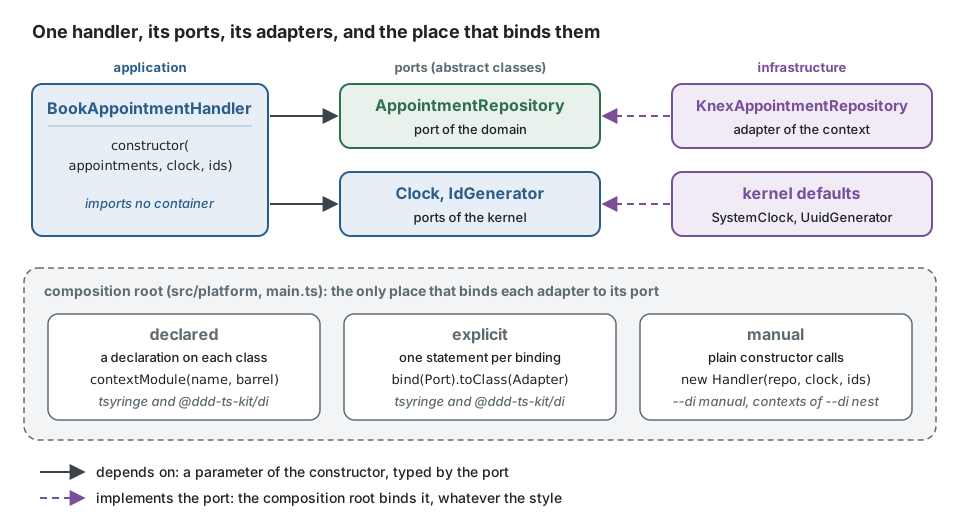
The handler of the running example books an appointment. It names what it needs by port, in its constructor, and nothing else:
import { definePermissions } from '@ddd-ts-kit/auth';import { AuthorizedCommand, type Actor, type Clock, type IdGenerator } from '@ddd-ts-kit/kernel';import { CommandHandler, Requires } from '@ddd-ts-kit/kernel/declarations';
// contexts/appointments/domain/aggregates/appointment.aggregate.ts, reduced to what the sample usesdeclare class Appointment {  static book(props: { id: string; clientId: string; startsAt: Date; bookedAt: Date }): Appointment;  readonly id: string;}
// contexts/appointments/domain/repositories/appointment.repository.ts: a port is an abstract classexport abstract class AppointmentRepository {  abstract save(appointment: Appointment): Promise<void>;}
// contexts/appointments/appointments.permissions.tsexport const appointmentsPermissions = definePermissions('appointments', {  'appointment.book': { description: 'Book an appointment' },});
// contexts/appointments/application/commands/book-appointment/book-appointment.command.ts@Requires(appointmentsPermissions['appointment.book'])export class BookAppointment extends AuthorizedCommand<string> {  constructor(    actor: Actor,    readonly startsAt: Date,  ) {    super(actor);  }}
// contexts/appointments/application/commands/book-appointment/book-appointment.handler.ts@CommandHandler(BookAppointment)export class BookAppointmentHandler implements CommandHandler<BookAppointment> {  constructor(    private readonly appointments: AppointmentRepository,    private readonly clock: Clock,    private readonly ids: IdGenerator,  ) {}
  async execute(command: BookAppointment): Promise<string> {    const appointment = Appointment.book({      id: this.ids.next(),      clientId: command.actor.id,      startsAt: command.startsAt,      bookedAt: this.clock.now(),    });
    await this.appointments.save(appointment);
    return appointment.id;  }}
The decorator comes from @ddd-ts-kit/kernel/declarations. It is metadata only: it
instantiates nothing and imports no container. What the handler depends on is said once, by
its constructor: ddd-ts-kit docs reads the signature from the source and writes the list
the container injects into the generated file of the context
(ports and composition, "How the constructor reaches
the composition root", compares this with a list in the decorator and with
emitDecoratorMetadata, which holds in three of the ten compiler and runner combinations
measured). The same handler class, without the decorator, is what NestJS or manual wiring
would bind.
What the rules refuse is a use case that fetches its own dependencies. Instead of reaching for the container, or building the adapter, inside the application layer:
// application/commands/book-appointment/book-appointment.handler.ts: refused// layer/application-inward: a container package and an infrastructure file, imported by the applicationimport { container } from 'tsyringe';import { KnexAppointmentRepository } from '@/contexts/appointments/infrastructure/persistence/knex-appointment.repository';
export class BookAppointmentHandler {  // composition/only-in-module: the adapter is chosen here, for good, and a test cannot replace it  private readonly appointments = new KnexAppointmentRepository();  // a hidden dependency: the constructor no longer says what the handler needs  private readonly clock = container.resolve(Clock);
  async execute(command: BookAppointment): Promise<string> { /* ... */ }}
write the constructor above: the handler receives its ports, a test gives it fakes, and the choice of the adapter stays in the composition root.
The same context, three composition roots
Section titled “The same context, three composition roots”The three styles bind the same classes. Only the place where the binding is written changes.
Declared (@ddd-ts-kit/di). Each class carries its declaration; the context is
assembled from the classes themselves. ddd-ts-kit docs writes, in the generated file of the
context, the list each constructor receives, and contextModule turns the declarations into
bindings:
import { AuthorizedCommand, Clock, IdGenerator, type Actor } from '@ddd-ts-kit/kernel';import { CommandHandler, Repository, injected } from '@ddd-ts-kit/kernel/declarations';import { contextModule, kernelModule } from '@ddd-ts-kit/di';import { createApplication } from '@ddd-ts-kit/di/tsyringe';
// the classes of the first sample, reduced to their shapedeclare class Appointment {  readonly id: string;}abstract class AppointmentRepository {  abstract save(appointment: Appointment): Promise<void>;}declare class BookAppointment extends AuthorizedCommand<string> {  constructor(actor: Actor, startsAt: Date);}
@CommandHandler(BookAppointment)class BookAppointmentHandler implements CommandHandler<BookAppointment> {  constructor(    private readonly appointments: AppointmentRepository,    private readonly clock: Clock,    private readonly ids: IdGenerator,  ) {}
  async execute(command: BookAppointment): Promise<string> {    // the body of the first sample    return `${this.ids.next()} booked at ${this.clock.now().toISOString()} for ${command.actor.id}`;  }}
// contexts/appointments/infrastructure/persistence/in-memory-appointment.repository.ts@Repository(AppointmentRepository)class InMemoryAppointmentRepository implements AppointmentRepository {  readonly saved: Appointment[] = [];
  async save(appointment: Appointment): Promise<void> {    this.saved.push(appointment);  }}
// contexts/appointments/application/application.declarations.ts, generated: never written by handinjected(BookAppointmentHandler, [AppointmentRepository, Clock, IdGenerator]);
// main.tsexport async function main(): Promise<void> {  const appointments = contextModule('appointments', { BookAppointmentHandler, InMemoryAppointmentRepository });  const app = createApplication({ modules: [kernelModule(), appointments] });
  await app.start();}
In a project, the composition root imports the whole generated barrel instead of naming the
classes: contextModule('appointments', appointments) after
import * as appointments from '@/contexts/appointments/appointments.declarations'. That file
only re-exports the generated declarations of each layer of the context, where the
injected statements are, one file per layer (application/application.declarations.ts).
Explicit (@ddd-ts-kit/di). Every binding is a statement of
<context>.module.ts, with the list of what each constructor takes. No decorator is needed:
import { definePermissions } from '@ddd-ts-kit/auth';import { AuthorizedCommand, Clock, IdGenerator, type Actor } from '@ddd-ts-kit/kernel';import { defineContextModule, kernelModule } from '@ddd-ts-kit/di';import { createApplication } from '@ddd-ts-kit/di/tsyringe';
// the classes of the first sample, without their decoratorsdeclare class Appointment {  readonly id: string;}abstract class AppointmentRepository {  abstract save(appointment: Appointment): Promise<void>;}declare class BookAppointment extends AuthorizedCommand<string> {  constructor(actor: Actor, startsAt: Date);}declare class BookAppointmentHandler {  constructor(appointments: AppointmentRepository, clock: Clock, ids: IdGenerator);  execute(command: BookAppointment): Promise<string>;}abstract class Database {  abstract readonly url: string;}declare class KnexAppointmentRepository implements AppointmentRepository {  constructor(database: Database);  save(appointment: Appointment): Promise<void>;}const appointmentsPermissions = definePermissions('appointments', {  'appointment.book': { description: 'Book an appointment' },});
// contexts/appointments/appointments.module.tsexport const appointmentsModule = defineContextModule({  name: 'appointments',  register(builder) {    builder.bind(Database).toValue({ url: 'postgres://localhost/appointments' });    builder.bind(AppointmentRepository).toClass(KnexAppointmentRepository, [Database]);    builder      .command(BookAppointment)      .requires(appointmentsPermissions['appointment.book'])      .handledBy(BookAppointmentHandler, [AppointmentRepository, Clock, IdGenerator]);  },});
// main.tsexport const app = createApplication({ modules: [kernelModule(), appointmentsModule] });
The compiler holds each list to its constructor: [Clock, AppointmentRepository, IdGenerator]
(another order) or [AppointmentRepository, Clock] (one short) does not compile.
Manual (--di manual, and the contexts of --di nest). A function of the platform builds
the objects with new and registers each handler on the bus; the generator writes the
registrations between markers of <context>.module.ts:
import { definePermissions, requires, type UseCaseDeclaration } from '@ddd-ts-kit/auth';import { AuthorizedCommand, type Actor, type Clock, type IdGenerator, type InMemoryCommandBus } from '@ddd-ts-kit/kernel';
// the classes of the first sample, without their decoratorsdeclare class Appointment {  readonly id: string;}interface AppointmentRepository {  save(appointment: Appointment): Promise<void>;}declare class BookAppointment extends AuthorizedCommand<string> {  constructor(actor: Actor, startsAt: Date);}declare class BookAppointmentHandler {  constructor(appointments: AppointmentRepository, clock: Clock, ids: IdGenerator);  execute(command: BookAppointment): Promise<string>;}declare class KnexAppointmentRepository implements AppointmentRepository {  constructor(databaseUrl: string);  save(appointment: Appointment): Promise<void>;}const appointmentsPermissions = definePermissions('appointments', {  'appointment.book': { description: 'Book an appointment' },});
// platform/composition/platform.ts, reduced: what every context receivesinterface Platform {  readonly commands: InMemoryCommandBus;  readonly clock: Clock;  readonly ids: IdGenerator;  readonly databaseUrl: string;}
// contexts/appointments/appointments.module.tsexport function appointmentsModule(platform: Platform): { name: string; useCases: readonly UseCaseDeclaration[] } {  const appointments = new KnexAppointmentRepository(platform.databaseUrl);
  // ddd-ts-kit:registrations  platform.commands.register(BookAppointment, new BookAppointmentHandler(appointments, platform.clock, platform.ids), {    context: 'appointments',  });  // /ddd-ts-kit:registrations
  return {    name: 'appointments',    useCases: [requires(BookAppointment, appointmentsPermissions['appointment.book'])],  };}
Here the compiler checks the arguments of each new, and nothing else. A use case missing
from useCases is found by ddd-ts-kit check (authz/declared reads the module file); a
handler that is never registered is found by the first command that reaches no handler, not at
start.
In a test, a module of @ddd-ts-kit/di (declared or explicit) runs as it is, with a fake
bound under the port class, a frozen clock and sequential identifiers:
import { anActor } from '@ddd-ts-kit/auth/testing';import { AuthorizedCommand, Clock, IdGenerator, type Actor, type CommandHandler } from '@ddd-ts-kit/kernel';import { defineContextModule, fake } from '@ddd-ts-kit/di';import { createTestApplication } from '@ddd-ts-kit/di/tsyringe';import { expect, it } from 'vitest';
// the port, the command and the handler of the first sample, in a few linestype Appointment = { readonly id: string; readonly bookedAt: Date };abstract class AppointmentRepository {  abstract save(appointment: Appointment): Promise<void>;}class BookAppointment extends AuthorizedCommand<string> {}class BookAppointmentHandler implements CommandHandler<BookAppointment> {  constructor(    private readonly appointments: AppointmentRepository,    private readonly clock: Clock,    private readonly ids: IdGenerator,  ) {}
  async execute(): Promise<string> {    const appointment = { id: this.ids.next(), bookedAt: this.clock.now() };    await this.appointments.save(appointment);
    return appointment.id;  }}const appointmentsModule = defineContextModule({  name: 'appointments',  register(builder) {    builder.command(BookAppointment).public().handledBy(BookAppointmentHandler, [AppointmentRepository, Clock, IdGenerator]);  },});
// contexts/appointments/test/fakes/in-memory-appointment.repository.ts: a fake implements the portclass InMemoryAppointmentRepository implements AppointmentRepository {  readonly saved: Appointment[] = [];
  async save(appointment: Appointment): Promise<void> {    this.saved.push(appointment);  }}
// contexts/appointments/test/unit/book-appointment.handler.spec.tsit('books the appointment at the instant of the clock, under a new id', async () => {  const appointments = new InMemoryAppointmentRepository();  const app = createTestApplication({    modules: [appointmentsModule],    fakes: [fake(AppointmentRepository, appointments)],    now: new Date('2026-03-02T08:00:00.000Z'),  });  const client: Actor = anActor().named('ada').build();
  const id = await app.commandBus.execute(new BookAppointment(client));
  expect(id).toBe('id-1');  expect(appointments.saved).toEqual([{ id: 'id-1', bookedAt: new Date('2026-03-02T08:00:00.000Z') }]);});
fake(AppointmentRepository, appointments) does not compile when appointments lacks a method
of the port. Manual wiring has no container to bind a fake in: its specs build the handler
with new and register it on createTestBuses() of @ddd-ts-kit/testing.
When several specs of a context build the same application, or the same buses, with the same
fakes, npx ddd-ts-kit generate test-world <context> writes that arrangement once, in
test/worlds/: see Worlds.
Comparison
Section titled “Comparison”@ddd-ts-kit/di |
NestJS container | Manual wiring | |
|---|---|---|---|
| Who assembles a context | the kit, from declarations (generated barrel or discovery) or from an explicit module | as generated, the same <context>Module(platform) function as manual wiring; Nest providers by factory when you bind in Nest modules yourself |
a <context>Module(platform) function in <context>.module.ts: plain calls to constructors, registrations between markers |
Style available (stack.style) |
declared or explicit, mixable |
explicit only |
explicit only |
| Injection token | the port class itself | Nest tokens; ports bound in the module | none: plain variables |
| What a class is given | what its constructor takes, each parameter typed by a port: read from the source into a generated file, never reflected | whatever the provider factory passes, or Nest's own design:paramtypes and @Inject when you declare providers by class |
the arguments of new Handler(a, b) |
| Decorators in your classes | declarations in application/ and infrastructure/, none in domain/; no parameter decorator, no reflection |
@Injectable() kept out of domain/ and application/ by rule; providers declared by factory |
none |
| Decorator mode | standard or legacy | legacy | not concerned |
| Errors found before start | duplicate binding, unbound dependency, cycle, duplicate handler, consumer or job, undeclared authorization, and more (WiringError with a code) |
Nest's own resolution errors at bootstrap | the compiler, for constructors; nothing for a forgotten handler |
| Cross-cutting hook | instrumentation of kernelModule (tracing, from outside), around(kinds, ...) in a module for every binding of a kind, .with(...) or the aspects of a declaration for one binding |
call the wrappers in the provider factory | call the wrappers by hand |
| Test application | createTestApplication with fake(Port, instance) |
Nest testing module, or createTestBuses |
createTestBuses |
| Extra runtime dependencies | tsyringe and reflect-metadata, inversify and reflect-metadata, or awilix |
the Nest packages | none |
The underlying libraries, checked on 2026-10-31
Section titled “The underlying libraries, checked on 2026-10-31”- tsyringe (Microsoft, MIT): latest npm version 4.10.0, published 2025-04-16; about 21
million downloads a week. The repository is not archived, but its last functional commits
date from April 2025 (the only later commit, September 2026, pins CI actions), its last
GitHub release tag is v4.4.0 from 2020, and 82 issues are open. In plain words: widely
used, stable, in low-activity maintenance. It refuses to load without
reflect-metadata(0.2.2, March 2024). - How much the kit depends on it.
@ddd-ts-kit/diuses a tsyringe child container as a registry: ports are registered under a symbol identity, dependencies are named in lists and never reflected, no tsyringe decorator appears in your code, andreflect-metadatais imported by the package only because tsyringe demands it. The surface exposed to tsyringe's future is therefore small, and the wiring checks are the kit's own. It is still a dependency on a quiet project: a team for which that is unacceptable has--di inversifyor--di awilix, which change the registry and nothing else. - NestJS (MIT):
@nestjs/core12.3.2, published 2026-10-27, about 23 million downloads a week, Node 20 or later, actively released. - InversifyJS (MIT):
inversify8.2.3, published 2026-07-23, about 3.7 million downloads a week, commits in October 2026 (inversify/monorepo), 11 open issues. - Awilix (MIT):
awilix13.0.5, published 2026-06-15, about 830,000 downloads a week, Node 20 or later, commits in October 2026, 7 open issues. - What the kit does with these two: the same as with tsyringe.
--di inversifyand--di awilixput one of them under@ddd-ts-kit/di, as a registry. The suite of the package runs on all three.
Five ways to wire, compared and measured
Section titled “Five ways to wire, compared and measured”InversifyJS and Awilix are the two containers a TypeScript team is most likely to ask for beside tsyringe, and each can be used in two ways that should not be confused:
- Under the kit,
--di inversifyor--di awilix.@ddd-ts-kit/dikeeps its declarations, its generators and its checks, and only the registry underneath changes. The code of the project is the code of a project on tsyringe:createApplicationcomes from another entry point, and nobody writesbind()orregister(). The gain is to stop depending on tsyringe. - By hand, on
--di manual. The team writes the API of the container in its module files, and gives up what the kit generates and checks (Writing their API by hand).
What follows says what each gives and what it costs. Everything marked as measured was compiled and run on 2026-10-31. Unless a column says "under the kit", InversifyJS and Awilix are used by hand, because that is where they differ: under the kit they behave as tsyringe does.
Why these two
Section titled “Why these two”Three conditions: a release in the last twelve months, more than 500,000 downloads a week, and a container one can use without adopting a framework. The figures were read on 2026-10-31.
| Container | Last release | Downloads a week | Verdict |
|---|---|---|---|
| InversifyJS 8.2.3 | 2026-07-23 | 3.7 million | kept: active, closest to tsyringe, and able to work without decorators |
| Awilix 13.0.5 | 2026-06-15 | 830,000 | kept: active, the opposite approach, no decorator and no reflection |
| typed-inject 5.0.0 | 2024-12-13 | 5.5 million | left out: no release for 22 months, and Stryker depends on it, so its downloads say little about who chooses it |
| injection-js 2.6.1 | 2025-10-22 | 1.8 million | left out: the injector of Angular taken out of Angular, and ng-packagr depends on it, so the same remark applies |
| TypeDI 0.10.0 | 2022-12-09 | 830,000 | left out: no release since 2022 |
| iti 0.8.0 | 2025-10-08 | 57,000 | left out: too few users |
@tsed/di 8.44.13 |
2026-10-29 | 38,000 | left out: the container of the Ts.ED framework |
| brandi 5.1.0 | 2026-01-15 | 31,000 | left out: too few users |
@needle-di/core 1.2.1 |
2026-09-04 | 28,000 | left out: too few users |
The same binding in each
Section titled “The same binding in each”The classes are those of the first example: only the lines that bind them differ.
// InversifyJS with a list: no decorator, and the compiler holds the list to the parameters of the functioncontainer  .bind(BookAppointmentHandler)  .toResolvedValue(    (appointments: AppointmentRepository, clock: Clock, ids: IdGenerator) =>      new BookAppointmentHandler(appointments, clock, ids),    [AppointmentRepository, Clock, IdGenerator],  );
// InversifyJS as its documentation writes it: decorators on the class itself@injectable()class BookAppointmentHandler {  constructor(    @inject(AppointmentRepository) private readonly appointments: AppointmentRepository,    @inject(Clock) private readonly clock: Clock,    @inject(IdGenerator) private readonly ids: IdGenerator,  ) {}}
// Awilix with a function: the cradle is the object that holds every registration, by namecontainer.register({  bookAppointmentHandler: asFunction(    ({ appointments, clock, ids }: Cradle) => new BookAppointmentHandler(appointments, clock, ids),  ).singleton(),});
// Awilix classic: no list at all, the names of the constructor parameters are the tokenscontainer.register({ bookAppointmentHandler: asClass(BookAppointmentHandler).singleton() });
The grid
Section titled “The grid”@ddd-ts-kit/di, on tsyringe, InversifyJS or Awilix |
NestJS | Manual | InversifyJS by hand | Awilix by hand | |
|---|---|---|---|---|---|
| The flag | --di tsyringe, the default, --di inversify, --di awilix |
--di nest, with --http nest only |
--di manual |
--di manual |
--di manual |
| What the generators write | every binding, declared or explicit | the hand-wired family: new in the module file |
new in the module file |
new beside your container, to move by hand |
new beside your container, to move by hand |
| Token | the port class | the port class | none: a variable | the port class | a string, the key of the cradle |
| How a dependency is named | a list, generated or written, held to the constructor by the compiler | inject, a list nothing holds to the factory |
the arguments of new |
a list held to the function by the compiler; or @inject |
a key of the cradle; or the name of the parameter in classic mode |
| Decorators in your classes | the kit's declarations, or none in the explicit style | none with providers by factory | none | none with lists; @injectable() and @inject() otherwise, refused in application/ and domain/ |
none |
| Decorator mode | standard or legacy | legacy | not concerned | either with lists; legacy with @inject(), a parameter decorator |
not concerned |
| Graph checked before the first message | yes, before anything is built | yes, everything is built at start | by the compiler | no: at each first get |
no: at each first resolve |
| Authorization and duplicate handlers at start | yes (WiringError) |
no | no | no | no |
| Replacing a port in a test | fake(Port, instance) |
Nest testing module, or createTestBuses |
new and createTestBuses |
a child container, or rebind; generated specs use new |
createScope and register; generated specs use new |
| Object per request | singleton or transient; the actor, the tenant and the correlation id go through ExecutionScope |
Scope.REQUEST |
by hand | inRequestScope: per call to get, not per HTTP request |
createScope and .scoped(): its strongest point |
| Closing a resource | onStop of a module |
onModuleDestroy |
by hand | onDeactivation, run by unbindAll |
.disposer(), run by dispose |
| Minified bundle | yes, with the barrel; never with discovery | yes, its optional packages left external | yes | yes | yes with functions; classic fails (below) |
| Project health, 2026-10-31 | low activity for tsyringe, active for the two others | active | no dependency | active | active |
When a wiring mistake is found
Section titled “When a wiring mistake is found”The most useful difference, and the one a feature list hides. Six mistakes were written on
purpose in a small application, once per way of wiring, then each case was compiled by tsc 7
and run; a seventh case without a mistake passed everywhere. The earlier the better: compile,
then start (before anything is served), first resolve, first call (the handler runs
and breaks), and never (nothing says anything).
| Mistake | @ddd-ts-kit/di, on any of the three |
NestJS, factories | Manual | InversifyJS by hand, lists | InversifyJS by hand, decorators | Awilix by hand, functions | Awilix by hand, classic |
|---|---|---|---|---|---|---|---|
| A port bound to nothing | start | start | compile | first resolve | first resolve | first resolve | first resolve |
| Two dependencies swapped | compile | first call | compile | compile | first call | compile | cannot happen: by name |
| One dependency left out | compile | first call | compile | compile | start | compile | a renamed parameter: first resolve |
| An adapter missing a method of its port | compile | first call | compile | compile | compile | first call | first call |
| A port bound twice | start | never: the last wins | compile | first resolve | first resolve | never: the last wins | never: the last wins |
| A cycle between two ports | start | start | compile | first resolve | first resolve | first resolve | first resolve |
Three readings:
- Manual wiring is the strictest column. It finds all six at compile time, because a variable must exist before it is passed. What it gives up lies elsewhere: a handler never registered, and a wrapper forgotten around an adapter, which no compiler sees.
- The kit's column is the same on the three containers, since these checks are its own.
- By hand, InversifyJS with lists is the stricter of the two, and its decorators give part
of that up: an
@injectthat names the wrong port compiles. Its errors name what is wrong (Ambiguous bindings found for service,Circular dependency found: A -> B -> A). - Awilix does not tie
registerto the type of the container:createContainer<Cradle>()types what you read, not what you write, so an incomplete adapter compiles, and a secondregisterreplaces the first without a word.
Resolving every handler at the end of the composition turns each "first resolve" into "start": the recipe below does so.
What it costs, measured
Section titled “What it costs, measured”| Way of wiring | Start, 91 bindings | Start, 346 bindings | Start, minified bundle | Bundle, minified / gzip | Heap | Resident memory | Resolve a singleton | Build three transient classes |
|---|---|---|---|---|---|---|---|---|
| Manual | 87 ms | 92 ms | 24 ms | 23 / 2 KiB | 8.7 MiB | 75 MiB | 43 ns | 46 ns |
| tsyringe alone | 94 ms | 102 ms | 28 ms | 56 / 11 KiB | 9.3 MiB | 75 MiB | 88 ns | 227 ns |
@ddd-ts-kit/di, explicit style |
125 ms | 133 ms | 36 ms | 146 / 40 KiB | 10.6 MiB | 85 MiB | 236 ns | 1,378 ns |
| InversifyJS, lists | 124 ms | 133 ms | 35 ms | 126 / 25 KiB | 11.2 MiB | 79 MiB | 59 ns | 110 ns |
| InversifyJS, decorators | 124 ms | 135 ms | 36 ms | 130 / 27 KiB | 11.4 MiB | 78 MiB | 64 ns | 110 ns |
| Awilix, functions | 102 ms | 109 ms | 36 ms | 123 / 32 KiB | 10.1 MiB | 78 MiB | 55 ns | 211 ns |
| Awilix, classic | 101 ms | 108 ms | fails | 118 / 32 KiB | 10.0 MiB | 77 MiB | 58 ns | 215 ns |
| NestJS, factories | 202 ms | 218 ms | 80 ms | 425 / 109 KiB | 17.3 MiB | 104 MiB | 58 ns | 5,447 ns |
The same application under the kit, one container per row, taken in a series of its own on the same day (manual wiring starts in 84 ms there, 3 ms under the first series):
@ddd-ts-kit/di on |
Start, 91 bindings | Start, 346 bindings | Start, minified bundle | Bundle, minified / gzip | Heap | Resident memory | Resolve a singleton | Build three transient classes |
|---|---|---|---|---|---|---|---|---|
| tsyringe | 120 ms | 130 ms | 37 ms | 146 / 40 KiB | 10.5 MiB | 85 MiB | 235 ns | 1,415 ns |
| InversifyJS | 149 ms | 161 ms | 42 ms | 204 / 51 KiB | 12.3 MiB | 84 MiB | 198 ns | 1,289 ns |
| Awilix | 128 ms | 137 ms | 43 ms | 211 / 61 KiB | 11.2 MiB | 86 MiB | 179 ns | 1,190 ns |
| What is installed | Packages | On disk |
|---|---|---|
tsyringe and reflect-metadata |
3 | 1.1 MB |
@ddd-ts-kit/di with them, kernel and scheduling included (the kernel is in every project of the kit) |
6 | 16 MB |
| InversifyJS | 8 | 6.9 MB |
| Awilix | 19 (its one dependency, fast-glob, brings the others) |
1.7 MB |
NestJS (core, common, rxjs, reflect-metadata) |
22 | 18 MB |
How it was measured: one workstation (Intel Core i7-12700H, 20 logical CPUs, 31 GB, Linux,
Node.js 26.13.0), @ddd-ts-kit/di and @ddd-ts-kit/kernel 0.105.0, tsyringe 4.10.0, InversifyJS
8.2.3, Awilix 13.0.5, @nestjs/core 12.3.2, tsc 7.0.2, esbuild 0.28.2. A generator writes the
same application once per way of wiring it: five contexts of four ports with their adapters, one
service and twelve command handlers of four dependencies each, three shared ports and a chain of
three transient classes, 91 bindings and 60 handlers; then twenty contexts, 346 bindings and 240
handlers. Every variant loads @ddd-ts-kit/kernel, as every project of the kit does; none has a
bus, a route or a database, so the figure is the container. The declared style was not measured.
A start is one new process, from its spawn to its exit once every handler is built: 40 runs per
variant taken in turn, under nice, the median in the table, the 90th percentile within 11
percent of it; an empty node process takes 18 ms. The bundle is esbuild with --bundle --minify
for Node 22, the optional packages of Nest left external. Memory is the median of 10 runs after
two forced garbage collections with every handler built. A resolve is the median of 5 processes
of five rounds each, 200,000 singletons and 50,000 graphs, in an async loop, as a message of the
bus is: the 43 ns of the manual row are that loop, a map read, and nothing else. NestJS builds a
transient graph through its asynchronous resolve. The load of the machine never passed 2.03, and
no run failed or was discarded.
What to take from it:
- Speed decides nothing. The gap between the fastest and the slowest singleton is 0.2 microseconds per message, against a millisecond for a query. The kit is the slowest here because each resolve checks the binding and watches for a cycle.
- By hand, InversifyJS starts in the time of the kit, without its checks. Awilix starts 23 ms sooner. In a minified bundle, where the loading of files is gone, the three are level at 35 to 36 ms.
- Under the kit, the choice costs milliseconds at start and nothing after. Awilix adds 8 ms to
tsyringe and InversifyJS 29 ms; both resolve a little faster than tsyringe. Between the two,
Awilix starts sooner, takes a quarter of the disk and needs no
reflect-metadata. - NestJS is the only one with a cost to plan for: 77 ms more than the kit at each start, 44 ms more in a minified bundle, about 7 MiB more heap and three times the bundle. It is the price of a framework that is there for other reasons, and it matters on a function started per request.
- Awilix classic does not survive a minifier, which renames the parameters it reads:
Could not resolve 'e', at the first resolve.--keep-namesdoes not help. Without minified identifiers it runs, undertsc,tsxand swc alike. @inject()needs the legacy mode. Under standard decoratorstscrefuses it (TS1206) andtsxfails to run it;@injectable()alone works in both modes. In legacy mode it ran undertsc,tsxand swc, with noemitDecoratorMetadata. InversifyJS importsreflect-metadataitself. None of this concerns--di inversify: the kit never uses its decorators.- Under the kit, InversifyJS refuses a promise bound to a port, at its first resolution: its
getis synchronous. tsyringe and Awilix hand it over. Bind what the promise gave.
Selection criteria
Section titled “Selection criteria”- Do you want the declared style? One decorator per class, no module file, no
dependency list: a generated barrel, which also registers what each constructor takes, kept
current by the generator (
declarations/barrel-current). Only@ddd-ts-kit/digives it, on any of its three containers, and it is their default: the CLI refuses--style declaredwith--di manualand--di nest, which default toexplicit.--di nestgoes with--http nestand the reverse. - Is NestJS already the framework? Then its container is there anyway (HTTP frameworks).
- How much checking at start do you want? The checks of
createApplication(a command with two handlers, two consumers sharing a name, a use case that declares no permission) are what manual wiring gives up. - Bundling and cold start. A barrel with
contextModuleis static and followed by a bundler; discovery reads directories at startup and cannot be bundled. - Dependency budget. Manual wiring adds nothing.
What this kit supports and verified
Section titled “What this kit supports and verified”From packages/di/README.md,
packages/kernel/README.md and
packages/cli/README.md:
- Constructor injection that holds whoever compiles: both decorator modes,
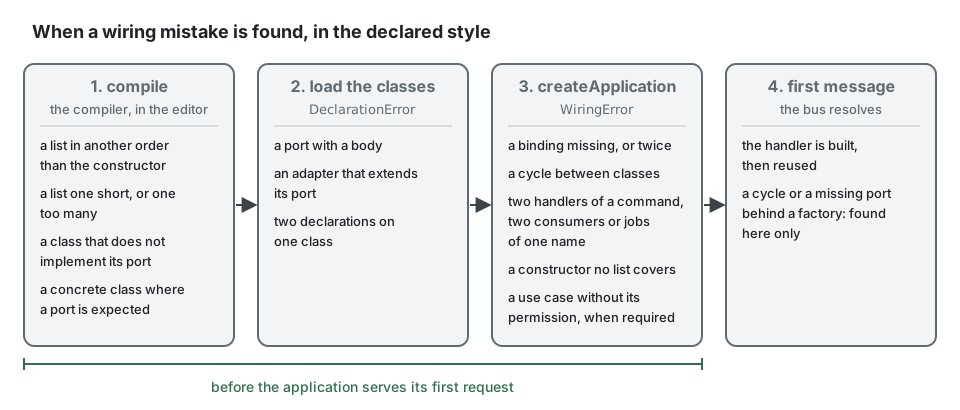
tsc6 and 7,tsx, Vitest and Jest with swc, because nothing is asked of the compiler at run time. - Compile-time checks, in both decorator modes: a generated or written dependency list that does not match the constructor, a class that does not implement the port it is declared the adapter of, a concrete class named where a port is expected.
- Load-time checks (
DeclarationError): a port with a body, an adapter that extends its port, two declarations on one class. - Start-time checks (
WiringError): duplicate or missing bindings, cycles between class bindings, duplicate handlers, consumers and jobs,rebindof nothing, a declared class whose constructor takes parameters and that no list covers, or a list of another length; withauthorization: 'required', a use case that declares neither a permission nor that it is public, and declarations that no module enforces. kernelModule()binds a working default for every kernel port (in-memory buses, unit of work, cache, lock, rate limiter, no-op logger and metrics), each replaceable by option or byrebind.- Two assemblies of a declared context (
stack.assembly):barrel(default) anddiscovery, with or without a broker.--assemblyis refused with--style explicit. - Proven end to end by the CLI (
proven-stacks.spec.ts, as its README lists them): generated projects in the declared style (the default stack; with ReBAC and RabbitMQ; with knex and discovery, alone and behind NATS), in the explicit style (the default stack; with ReBAC and RabbitMQ), on InversifyJS and on Awilix (the default stack at each pull request; the explicit style, ReBAC and RabbitMQ, knex and discovery, Prisma, TypeORM and the identity preset at night and before a release), with--di manual(with ABAC and knex; with Fastify, knex, RabbitMQ and Redis), and one NestJS stack (its controllers, class-validator, Passport). - Test application with fixed clock, sequential identifiers, in-memory buses and fakes bound under the port class.
The checks above catch each mistake at the earliest of four moments; only a dependency resolved inside a factory waits for the first message that builds the class:
Limits and when not to use it
Section titled “Limits and when not to use it”Stated by the package:
- A class plays one role: one declaration per class. An adapter that implements two ports is bound explicitly, once per port.
- A declaration is not inherited: a subclass declares itself or is bound explicitly.
- Names (consumer, policy, job, domain event) are written in the declaration, never derived from the class name.
- A port of your own is identified by its class: loaded from two copies of a package it is two
tokens, unless it declares a
tokenKey. An application compiled as one program never meets this. - Factories do not declare what they resolve: a cycle or a missing port going through a factory is reported when it is resolved, not at start.
- Discovery imports files that nothing else imports: knip and dependency-cruiser must be told, it runs sequentially at startup, and a bundler cannot follow it.
- A class decorator of another library that replaces the class must sit below the kit's declaration.
Of the alternatives:
- NestJS: explicit style only; the kit's routes bypass Nest's request pipeline; the legacy decorator mode applies to the whole program; the start-time checks above are replaced by Nest's.
- Manual: no check that every handler is registered or every use case protected beyond
what
ddd-ts-kit checkreads in the text (authz/declared,events/consumer-idempotent); cross-cutting wrappers are applied by hand, so one forgotten call is one untraced adapter.
Do not introduce a container at all in a script, a migration or a context of three classes run alone: constructing the objects by hand is the composition root.
Recommendation by situation
Section titled “Recommendation by situation”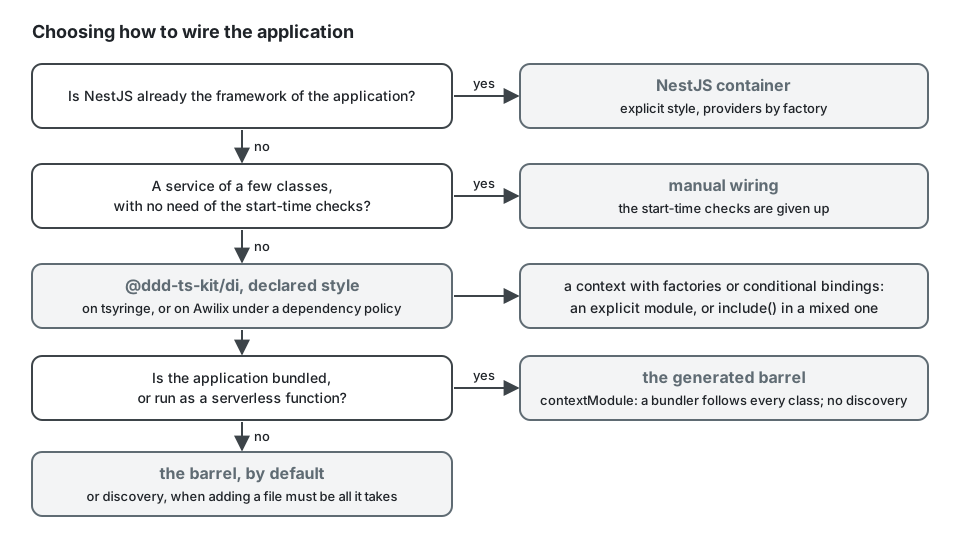
By need of the project
Section titled “By need of the project”| Situation | Choice |
|---|---|
| New project on Express or Fastify | tsyringe with the declared style and a barrel: the default, the most generated, the most checked |
| Unusual wiring in one context (factories, conditional bindings) | the same, with an explicit module for that context, or include in a mixed module |
| Serverless or bundled deployment | @ddd-ts-kit/di, contextModule with the barrel, on any of its containers; avoid discovery |
| Existing NestJS application | NestJS container, explicit style, providers by factory |
| A policy against low-activity dependencies | --di awilix, or --di inversify if the team knows it: everything the default gives, on an active project, for 8 and 29 ms at start |
| A very small service | manual wiring, knowing which start-time checks are given up |
| Every invocation starts a process, each millisecond counted | manual wiring in a minified bundle: 24 ms, against 36 for the kit and 80 for NestJS |
| Many objects that live for one request | ExecutionScope first: it already carries the actor, the tenant and the correlation id. Beyond that, Awilix with createScope on --di manual |
By affinity: the team insists on a technology
Section titled “By affinity: the team insists on a technology”A team that knows a tool well has a real reason to keep it. The table says what to do, and what
that choice keeps and pays. First ask what is wanted of the tool: its presence in the dependencies
is --di inversify or --di awilix, and costs next to nothing; its API in your code is the
hand-written path, and costs the generators and the checks. Written by hand, neither container
finds a mistake sooner than the kit, and manual wiring finds all six at compile time.
| The team wants | Do this | It keeps | It pays |
|---|---|---|---|
| tsyringe | --di tsyringe, the default; @injectable() and @inject() of tsyringe stay out of your code |
everything in this page | the habit of its decorators: dependencies are listed, never reflected |
| NestJS | --http nest, which brings --di nest; providers by factory |
its modules, lifecycle and testing module | the declared style, the checks of createApplication, a list of inject nothing holds to the factory, 77 ms at each start |
| InversifyJS, as a dependency | --di inversify |
everything in this page, and the native container at application.container |
no bind() in your code, 29 ms at each start, a promise bound to a port refused |
| InversifyJS, its API in your code | --di manual, bindings with lists in <context>.module.ts, no decorator in application/ |
its binding API, lists the compiler checks, errors that name a cycle or a double binding, onDeactivation |
the generators, which write new beside it; the checks of createApplication; a move by hand after each generate |
| Awilix, as a dependency | --di awilix |
everything in this page, and the native container at application.container |
no register() in your code, 8 ms at each start |
| Awilix, its API in your code | --di manual, functions over a typed cradle in <context>.module.ts; classic mode only if identifiers are never minified |
the cradle, createScope, .disposer(), container.registrations to resolve everything at start |
the same as InversifyJS by hand, and a port bound twice or an incomplete adapter that compiles |
| No container at all | --di manual, as generated |
every mistake above at compile time, no dependency | the checks of createApplication, wrappers applied by hand |
Writing the API of InversifyJS or Awilix by hand
Section titled “Writing the API of InversifyJS or Awilix by hand”For a team that wants bind() or register() in its own code; otherwise --di inversify and
--di awilix do the wiring. Tried on a project generated by 0.105.0 with
--di manual --http express, one context, one
repository, one command. With either container in place of the generated lines, typecheck,
ddd-ts-kit check, ddd-ts-kit lint and dependency-cruiser pass, and a command sent through the
composed application reaches its handler. The samples are not compiled by the pipeline of this
repository, which depends on neither library. The context builds its container in its module
file, the one file of a context allowed to know every layer:
function registerHandlers(platform: Platform): void {  const container = billingContainer(platform);
  // ddd-ts-kit:handlers  platform.commands.register(IssueInvoiceCommand, container.get(IssueInvoiceHandler), { context: 'billing' });  // /ddd-ts-kit:handlers}
function billingContainer(platform: Platform): Container {  const container = new Container({ defaultScope: 'Singleton' });
  container    .bind(InvoiceRepository)    .toResolvedValue(() =>      platform.adapter(new InMemoryInvoiceRepository(), {        kind: 'repository',        context: 'billing',        token: 'InvoiceRepository',      }),    );
  container    .bind(IssueInvoiceHandler)    .toResolvedValue((invoices: InvoiceRepository) => new IssueInvoiceHandler(invoices), [InvoiceRepository]);
  return container;}
With Awilix, billingContainer declares a cradle and registers functions, and the handler comes
from container.resolve('issueInvoiceHandler'):
interface BillingCradle {  invoiceRepository: InvoiceRepository;  issueInvoiceHandler: IssueInvoiceHandler;}
function billingContainer(platform: Platform): AwilixContainer<BillingCradle> {  const container = createContainer<BillingCradle>({ injectionMode: InjectionMode.PROXY, strict: true });
  container.register({    invoiceRepository: asFunction(() =>      platform.adapter(new InMemoryInvoiceRepository(), {        kind: 'repository',        context: 'billing',        token: 'InvoiceRepository',      }),    ).singleton(),    issueInvoiceHandler: asFunction(      ({ invoiceRepository }: BillingCradle) => new IssueInvoiceHandler(invoiceRepository),    ).singleton(),  });
  return container;}
Asking for the handler while the module registers it builds the graph at start: a port bound to nothing or a cycle then stops the application before it serves anything. What holds, and what to watch:
- The container stays in the module file. A container imported in
domain/orapplication/is refused (layer/*, incheck, in the lint and in dependency-cruiser), so@injectable()on a handler is refused. On a class ofinfrastructure/it passes. - Every adapter still goes through
platform.adapter. It is what applies the tracing and the resilience; a binding that skips it leaves an adapter untraced, and nothing reports it. generatekeeps writingnew, and nothing warns you. The nextgenerate commandon this module added its ownnew InMemoryInvoiceRepository()between the markers, beside the container: it compiled andddd-ts-kit checkreported nothing, with two instances of the repository, and the state of an in-memory adapter split between them. After eachgenerate, move what it wrote into the container.- A handler never registered stays invisible.
checkdoes not see it, as with manual wiring: the first command finds it. - The specs do not go through your container. A generated spec builds the handler with
newand runs it oncreateTestBuses. That is what keeps it fast; it also means a mistake in the container is not found by a unit spec.
Sources
Section titled “Sources”- tsyringe: https://github.com/microsoft/tsyringe (commits, releases and issues read on
2026-10-31); npm registry entry
tsyringe. - NestJS documentation, custom providers: https://docs.nestjs.com/fundamentals/custom-providers
- InversifyJS: https://inversify.io and https://github.com/inversify/monorepo ; Awilix: https://github.com/jeffijoe/awilix ; npm registry entries and the weekly figures of https://api.npmjs.org/downloads, read on 2026-10-31.
- TypeScript 5.0 release notes, decorators: https://www.typescriptlang.org/docs/handbook/release-notes/typescript-5-0.html
- Robert C. Martin, Clean Architecture, Prentice Hall, 2017, chapter 26 ("The Main Component").
- Mark Seemann, "Composition Root" (2011): https://blog.ploeh.dk/2011/07/28/CompositionRoot/
- Martin Fowler, "Inversion of Control Containers and the Dependency Injection pattern" (2004): https://martinfowler.com/articles/injection.html