
Quelle commande, quand
Résumé. Les commandes de la CLI et les skills du plugin, rangés selon le moment de la vie d'un projet où on les appelle : ce que fait chacun, ce qu'il laisse derrière lui, et ce qui vient d'habitude ensuite. L'ordre des moments est celui de la méthodologie, qui est le chemin pris en charge ; cette page dit comment le parcourir. La dernière partie est la référence de chaque commande et de chaque option, générée à partir de l'aide de la CLI.
Les commandes sont écrites pour npm. Sous pnpm, npx ddd-ts-kit se lit pnpm exec ddd-ts-kit et
npm run se lit pnpm run. Un skill se tape dans Claude Code, le plugin installé :
/ddd-ts-kit:<skill> ; l'agent utilise aussi la plupart d'entre eux de lui-même quand la
situation s'y prête.
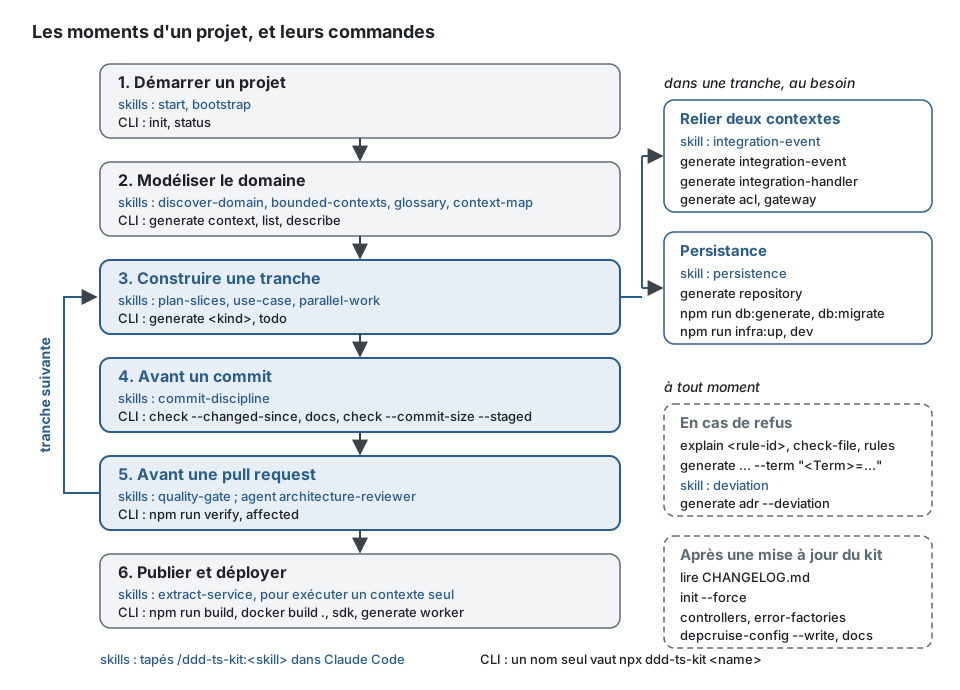
Les sections ci-dessous suivent ces moments. L'essentiel du temps se passe dans la boucle qui va de Construire une tranche à Avant une pull request, une tranche par tour de boucle.
Une première fonctionnalité, à partir de zéro
Section intitulée « Une première fonctionnalité, à partir de zéro »La séquence réaliste pour un service de prise de commandes, chaque ligne dans l'ordre où on la tape :
| # | Commande | Laisse |
|---|---|---|
| 1 | /ddd-ts-kit:start We take orders from shops and bill them monthly |
docs/architecture/plan.md, puis discovery.md, contexts.md, le glossaire et la carte des contextes, une étape par tour, chacune close sur votre oui |
| 2 | /ddd-ts-kit:bootstrap (ou npx ddd-ts-kit init, npm install, npm run verify) |
le projet, vert avant tout code métier |
| 3 | npx ddd-ts-kit generate context ordering --classification core --term "Order=A shop's request to buy products" --term "Place=To submit an order" |
src/contexts/ordering/ et son CONTEXT.md avec le glossaire |
| 4 | /ddd-ts-kit:plan-slices |
docs/architecture/slices.md : PlaceOrder d'abord |
| 5 | /ddd-ts-kit:use-case PlaceOrder, qui lance generate aggregate ordering Order, generate repository ordering Order, generate command ordering PlaceOrder --permission order.place --aggregate Order --creates, generate route ordering PlaceOrder --method POST --path /orders, generate e2e ordering PlaceOrder |
les fichiers, leurs specs et leurs fakes, et les endroits TODO(domain) à remplir |
| 6 | npx ddd-ts-kit todo ordering |
ce qui reste à écrire dans la tranche, sous forme de file:line |
| 7 | npm run db:generate place-order, npm run docs:generate |
la migration de la nouvelle table, le contrat OpenAPI avec POST /orders |
| 8 | /ddd-ts-kit:quality-gate, c'est-à-dire npm run verify |
une porte verte |
| 9 | /ddd-ts-kit:commit-discipline |
un commit pour la tranche, les fichiers générés avec lui |
| 10 | npx ddd-ts-kit status |
la tranche suivante du plan |
La ligne 5 est celle où les générateurs tapent à votre place. Avec Drizzle choisi à init, les
cinq commandes qu'elle lance écrivent ces fichiers, chacun dans sa couche :
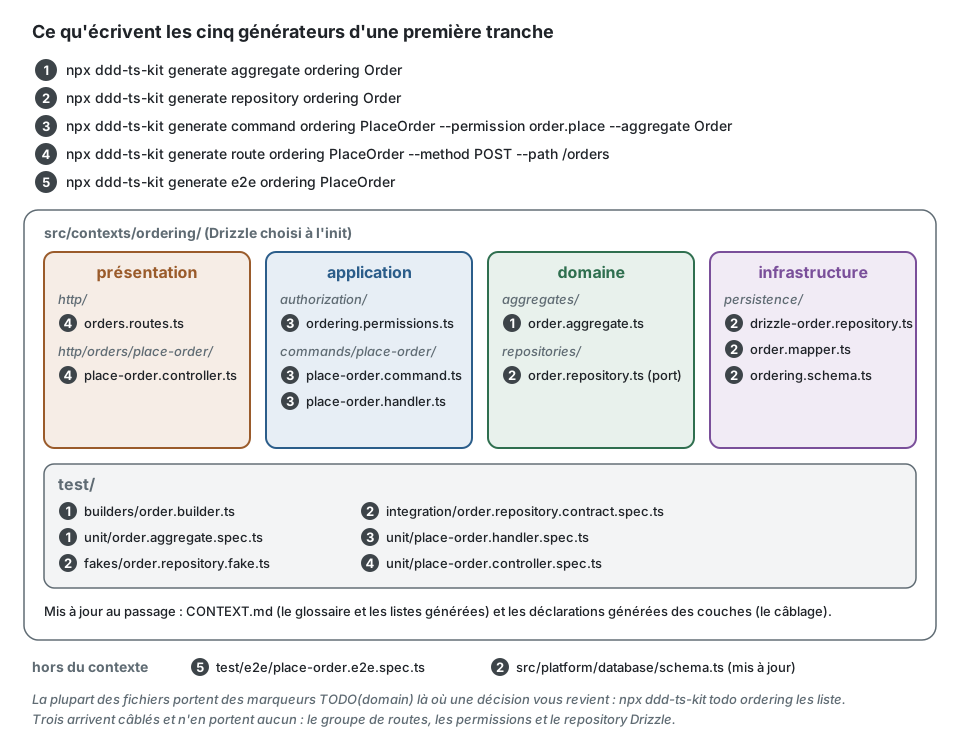
Aucun de ces fichiers ne contient encore de code métier. La plupart contiennent des marqueurs
TODO(domain) là où une décision vous revient ; trois arrivent câblés et n'en contiennent aucun
(le groupe de routes orders.routes.ts, les permissions ordering.permissions.ts et
l'adaptateur drizzle-order.repository.ts). Les specs générées contiennent des entrées
it.todo. La ligne 6 les liste, une ligne chacun, dans l'ordre des fichiers :
$ npx ddd-ts-kit todo orderingsrc/contexts/ordering/CONTEXT.md:5 TODO(domain) say in two sentences which business capability this context owns and for whom; the first sentence is reused in the context map.src/contexts/ordering/application/commands/place-order/place-order.command.ts:7 TODO(domain) declare the input of "place order" as a constructor with the actor first, then readonly primitives and ids, ...src/contexts/ordering/application/commands/place-order/place-order.handler.ts:16 TODO(domain) decide what "place order" does to a Order: ...src/contexts/ordering/domain/aggregates/order.aggregate.ts:19 TODO(domain) record the fact Order is born with at `now`, the instant the handler takes from its Clock: `ddd-ts-kit generate domain-event ordering Order <Fact>` writes the event, then ......src/contexts/ordering/test/unit/order.aggregate.spec.ts:30 it.todo records the fact of its birth...La tranche est finie quand todo ordering n'en liste plus rien.
La route lit la commande qu'elle appelle : remplissez le constructeur de PlaceOrderCommand avant
generate route, et la route écrit son schéma de corps, l'appel
new PlaceOrderCommand(request.actor, request.body.customerId, ...) et une spec qui envoie un
corps valide à partir de ces champs, une chaîne, un nombre ou un booléen chacun (un paramètre du
chemin est lu dans le chemin). Un champ d'un autre type, le readonly string[] des produits par
exemple, reste un TODO(domain) du schéma et de l'appel.
Démarrer un projet
Section intitulée « Démarrer un projet »| Commande ou skill | Fait | Quand | Produit | Ensuite |
|---|---|---|---|---|
/ddd-ts-kit:start |
conduit les étapes 1 à 7 de la méthode, une par tour, et reprend à partir du plan | en premier, avant tout code ; de nouveau pour reprendre | docs/architecture/plan.md et l'artefact de chaque étape |
l'étape que nomme sa ligne Next: |
/ddd-ts-kit:bootstrap |
choisit la stack selon des critères, lance init, crée les contextes |
étape 5, une fois la carte des contextes esquissée | le projet et un CONTEXT.md par contexte |
/ddd-ts-kit:plan-slices |
npx ddd-ts-kit init [flags] |
écrit la configuration, la plateforme, le pipeline, les règles de l'agent ; relancé, il garde la stack enregistrée : une valeur de drapeau invalide est refusée, un drapeau qui diffère de l'enregistré est noté et gardé (init --force le change) |
l'amorçage ; --dry-run d'abord pour lire ce qu'il écrit |
un projet qui passe npm run verify |
npm install, npm run verify |
npx ddd-ts-kit init --preset identity, generate context <name> --preset identity |
écrit un contexte générique en entier au lieu d'un contexte vide : les comptes venus du fournisseur d'identité, les organisations, les membres et les rôles, les invitations, les délégations (pourquoi et lesquels) | quand contexts.md contient un contexte générique d'identité |
le contexte, ses specs, ses adaptateurs et son glossaire, verts d'emblée | lire sa section ## Design, puis les tranches du cœur |
npx ddd-ts-kit status |
la prochaine étape du plan, les tranches par statut et par responsable, ce qui reste par contexte | au début de chaque session | un texte court, --json pour des données ; un merge laissé en cours est sa première ligne |
l'étape ou la tranche qu'il nomme, ou merge-trunk --continue ou --abort |
Modéliser le domaine
Section intitulée « Modéliser le domaine »| Commande ou skill | Fait | Quand | Produit | Ensuite |
|---|---|---|---|---|
/ddd-ts-kit:discover-domain |
un event storming écrit : acteurs, commandes, événements, politiques, modèles de lecture | étape 1 | docs/architecture/discovery.md |
/ddd-ts-kit:bounded-contexts |
/ddd-ts-kit:bounded-contexts |
trouve et classe les contextes, avec la raison de chaque frontière | étape 2 | docs/architecture/contexts.md |
/ddd-ts-kit:glossary |
/ddd-ts-kit:glossary |
le langage omniprésent d'un contexte | étape 3, et avant tout nouveau nom | docs/architecture/glossary.md, puis le ## Ubiquitous language de chaque CONTEXT.md |
/ddd-ts-kit:context-map |
/ddd-ts-kit:context-map |
amont, aval, patron et contrat de chaque paire | étape 4, et quand deux contextes commencent à dépendre l'un de l'autre | docs/architecture/context-map.md, puis les amonts de la configuration |
l'amorçage, ou la tranche qui en a besoin |
npx ddd-ts-kit generate context <name> --classification <c> --reason "..." --term "<Term>=<meaning>|<not to be confused with>" ... --upstream ... |
déclare un contexte avec son langage, la phrase qui dit pourquoi il a sa classification, et ses relations ; sur un contexte qui existe, déclare chaque --upstream qu'il ne déclare pas encore, et refuse celui qui ferme un cycle |
après l'amorçage, un par ligne de contexts.md, les amonts d'abord |
le répertoire du contexte, son CONTEXT.md, l'entrée de configuration |
npx ddd-ts-kit docs |
npx ddd-ts-kit list, describe <context> |
ce qui existe, par contexte ou pour un seul | avant de planifier ou de modifier un contexte | une carte des contextes, ou un contexte sous forme de faits (--json) |
/ddd-ts-kit:plan-slices |
npx ddd-ts-kit generate module <context> <module> --purpose "..." [--term ...] |
déclare un module du modèle : l'entrée de la configuration, sa ligne de ## Modules dans CONTEXT.md, ses termes, et dans le style explicite son fichier de module <module>/<module>.module.ts, composé par <context>.module.ts ; peut être relancé, il ajoute ce qui manque |
quand un contexte tient des groupes de concepts d'un même langage qu'un lecteur ouvre séparément ; jamais pour cacher un second langage | le module, déclaré et documenté | move-to-module, puis generate ... --module |
npx ddd-ts-kit move-to-module <context> <module> <path>... [--dry-run] [--allow-cycle] |
déplace des fichiers et des dossiers des couches d'un contexte, et ses specs, fakes et builders, dans un module déclaré (<module>/<layer>/, <module>/test/), avec chacun de leurs imports dans le projet ; n'écrit rien quand le déplacement fermerait un cycle entre modules qui n'existe pas aujourd'hui, et nomme le cycle et le fichier à déplacer avec, sauf avec --allow-cycle |
un groupe par commit, jusqu'à ce que module/complete n'avertisse plus |
les fichiers déplacés et les imports réécrits | npm run verify |
Construire une tranche
Section intitulée « Construire une tranche »| Commande ou skill | Fait | Quand | Produit | Ensuite |
|---|---|---|---|---|
/ddd-ts-kit:story <code> [<énoncé>] |
une user story de ses questions à une pull request verte, dans son propre worktree : les questions d'abord, puis spécification, lignes, revue de conception, acceptation, construction, revue, rapport (parcours d'une story) | une fois le projet amorcé, un terminal par story | la pull request de la story et son rapport | relire le rapport, valider chaque décision provisoire |
npx ddd-ts-kit story-scope <code> |
le worktree d'une story sur story/<code>, son .ddd-ts-kit/story.json et son installation ; les autres stories ouvertes et leurs contextes |
la première étape de la skill story | .worktrees/<code> |
npx ddd-ts-kit story <code> |
npx ddd-ts-kit stories |
les stories ouvertes dans les worktrees du dépôt et où deux d'entre elles se croisent : les contextes que les deux nomment, les fichiers que les deux changent, ce que la fusion de l'une dans l'autre laisse à régler à la main, le retard de chacune sur son tronc | avant de découper les lignes d'une story et avant chaque ligne, après git fetch |
un texte court, --json pour des données ; code de sortie 0 |
se tenir à l'écart de ce qu'une autre story change, ou consigner laquelle arrive la première |
npx ddd-ts-kit worktree <name> |
le worktree de tout travail qui n'est ni une story ni un worker : .worktrees/<name> sur work/<name> coupé de origin/main, installé |
avant d'écrire le code d'un contexte depuis le checkout principal du tronc, que la garde refuse dans un projet créé par init |
le worktree, sa branche et son installation | y travailler, commiter, ouvrir sa pull request |
npx ddd-ts-kit story [<code>] [--gate build|close] |
les phases d'une story et l'étape suivante ; build ouvre son code, close sa pull request |
à tout moment dans le worktree d'une story | un texte court, --json pour des données ; code de sortie 1 tant que la barrière n'est pas franchie |
faire l'étape suivante |
npx ddd-ts-kit digest --base <ref> |
ce que change la branche, pour qui la relit : par contexte, les cas d'usage, les permissions et les rôles qui les détiennent, les routes et leurs codes d'erreur, les événements et les ports ajoutés, modifiés ou retirés depuis la base de fusion ; les nouveaux titres de spec ; les fichiers à relire dans l'ordre de lecture, les fichiers générés à part | à la clôture d'une story, dans ## Report ; en tête de sa pull request |
une trentaine de lignes de Markdown, --json pour des données ; code de sortie 2 hors de git ou sur une référence inconnue |
la relecture le lit avant le diff |
/ddd-ts-kit:plan-slices |
le travail en tranches verticales, ordonnées, avec leurs commandes de générateur | étape 6, après l'amorçage | docs/architecture/slices.md |
/ddd-ts-kit:use-case |
npx ddd-ts-kit cited --rows <id> --base origin/main |
les noms que la conception d'une ligne cite comme du code et que le tronc n'a pas : retirés par son historique (avec le commit et ce qui les remplace), refusés par l'arborescence canonique, ou proches d'un nom qu'il a gagné depuis que la ligne a été écrite ; un nom prévu reste muet | avant de construire seul une ligne, avant de committer une revue de conception | une ligne par nom, --json pour les données ; code de sortie 0 |
construire sur ce que le tronc a, et corriger le document sur le tronc |
npx ddd-ts-kit generate acceptance <story>, puis npx ddd-ts-kit acceptance <story> --lock |
la spec d'acceptation d'une story, un it.todo par critère de docs/architecture/stories/<story>.md, à écrire en scénarios enveloppés dans pending(...) ; le verrou les enregistre, après quoi un scénario ne change qu'avec son critère, et un critère ou un scénario dont les critères n'ont pas changé seulement avec un verdict de l'agent acceptance-judge |
avant la première ligne de code d'une story | test/acceptance/<story>.acceptance.spec.ts et son .lock.json |
npx ddd-ts-kit acceptance <story> --gate written, puis les lignes |
npx ddd-ts-kit acceptance [<story>] [--gate written|passing] |
les scénarios de chaque story face à ses lignes et à ses critères : à écrire, en attente, dérivés du verrou, incohérents, et les amendements à valider | avant le code d'une story (written), avant de la clore (passing) |
un texte court, --json pour des données ; code de sortie 1 tant que la barrière demandée n'est pas franchie |
écrire, verrouiller, construire, ou signaler les amendements |
/ddd-ts-kit:use-case <UseCase> |
une tranche de bout en bout, test d'abord | pour chaque ligne des tranches | domaine, gestionnaire, route et specs, remplis | npm run verify |
npx ddd-ts-kit generate <kind> ... |
un fichier d'un rôle avec sa spec, son fake et son enregistrement (liste ci-dessous) ; --module <module> écrit dans un module du modèle, et est requis dans un contexte qui déclare des modules |
chaque fois qu'il faut un fichier d'un rôle, jamais à la main | le fichier et les endroits TODO(domain), --json pour la liste |
remplir les endroits, puis todo |
npx ddd-ts-kit todo [<context>] |
chaque TODO(domain), TODO(platform), it.todo et TODO(review) restant, dans le code, les pages, les fichiers de prisma/schema/ (sous le contexte du fichier ou du modèle), les migrations et la configuration à la racine |
avant de clore une tranche, une story ou un jalon | des entrées file:line, avec leurs seuls premiers mots sous --brief |
les écrire, puis npm test ; régler chaque TODO(review) ou l'écarter par generate adr avant de clore la story ou le jalon |
npx ddd-ts-kit story-check <code> [--strict] |
si une story ou un jalon (M1 pour les lignes M1.*) peut être clos : chaque ligne done, aucun marqueur qui lui appartient, un marqueur lui appartenant quand son texte, le commit qui l'a écrit ou le worker qui le porte nomme une de ses lignes, ou quand il n'appartient à aucune ligne dans un contexte où aucune autre story ouverte ne travaille |
avant de déclarer clos une story ou un jalon ; status nomme celui dont les lignes sont faites mais que des marqueurs gardent ouvert |
une ligne quand il peut être clos ; sinon chaque marqueur bloquant avec la raison pour laquelle il est à lui, son file:line et sa correction, puis les marqueurs non attribués listés sans bloquer ; sort avec 0, 1, ou 2 sur un code inconnu |
traiter chaque marqueur bloquant ou l'écarter par generate adr, puis supprimer le marqueur ; nommer la ligne dans un marqueur non attribué (TODO(review): #M1.03 ...) |
npx ddd-ts-kit measures [--since <date>] [--story <code>] |
ce que la boucle de chaque story a coûté et laissé, depuis git et docs/architecture/ : temps de conception, de construction et de livraison, les exigences changées après le début de la construction, les décisions provisoires, les compromis, les marqueurs de revue réglés et les constats répétés d'une story à l'autre, la vérification, les stories construites en même temps, l'origine, les incidents répétés ; puis les médianes de la période ; --by-author seulement quand l'équipe en a convenu |
une fois par mois, par qui règle l'installation ; avant une rétrospective | une ligne par story et les médianes, --json pour un tableau de bord ; sort avec 0 |
une remarque répétée devient une ligne d'AGENTS.md ou une règle de la config ; un long temps de conception, une question posée plus tôt |
/ddd-ts-kit:parallel-work |
répartit les tranches entre des workers, un contexte chacun | quand plusieurs agents ou personnes construisent en même temps | une consigne par worker, des worktrees npx ddd-ts-kit worker-scope <context>, avec les documents de la conception de chaque ligne et les noms qu'ils citent que le tronc n'a pas |
le use-case de chaque worker |
npx ddd-ts-kit status --workers |
le worktree, la branche, le contexte, les lignes et l'avance de chaque worker, son état (lignes commitées, ligne en cours, dernier verify-slice), les fichiers qu'il a changés, et ceux que deux workers changent | avant de confier une consigne à un second worker dans un contexte, avant chaque fusion | un texte court, --json pour des données |
d'autres lignes pour le nouveau worker, l'ordre des fusions, ou --resume pour un worker arrêté |
npx ddd-ts-kit worker-scope <context> --resume |
où en est un worker arrêté (lignes d'après leur trailer Slice:, fichiers de la ligne en cours, marqueurs, dernier verify-slice, rapport, agent), lu sans rien changer |
sur une notification d'arrêt d'un context-builder (limite de tours, erreur, une personne) |
le texte du SendMessage pour son agent, ou la consigne d'un nouvel agent | l'envoyer tel quel |
Relier deux contextes
Section intitulée « Relier deux contextes »| Commande ou skill | Fait | Quand | Produit | Ensuite |
|---|---|---|---|---|
/ddd-ts-kit:integration-event |
un événement versionné dans le langage publié du producteur, son consommateur en aval | un contexte doit réagir à un autre | la déclaration, la publication par l'outbox, un gestionnaire idempotent | npm run docs:generate |
npx ddd-ts-kit generate integration-event <context> <Aggregate> <Fact> |
déclare l'événement | dans la tranche amont | published-language/*.integration-event.ts et sa charge utile |
generate integration-handler en aval |
npx ddd-ts-kit generate integration-handler <context> <upstream> <eventType>[@v<n>] |
le consommateur, nommé d'après l'événement, ou comme la conception l'appelle avec --name <Name> (le nom du consommateur suit) |
dans la tranche aval | le gestionnaire, sa spec, son enregistrement | npm run docs:generate |
npx ddd-ts-kit generate acl ou gateway |
une couche anticorruption, ou un besoin synchrone derrière un port | un aval qui ne doit pas prendre le modèle de l'amont | le port et son adaptateur | la note de la carte des contextes |
Persistance
Section intitulée « Persistance »| Commande ou skill | Fait | Quand | Produit | Ensuite |
|---|---|---|---|---|
/ddd-ts-kit:persistence |
port de repository, adaptateur ORM, mapper, fake, suite de contrat | un nouvel agrégat, une nouvelle table ou un nouveau modèle de lecture | l'adaptateur et ses specs | npm run db:generate <what-it-does> |
npx ddd-ts-kit generate repository <context> <Aggregate> |
le port, le fake en mémoire et l'adaptateur ORM | avec la première tranche d'un agrégat | les fichiers et la table du schéma à remplir | npm run db:generate <what-it-does> |
npm run db:generate <what-it-does> |
une migration à partir du schéma, nommée <timestamp>_<what-it-does> |
après un changement du schéma | migrations/ (prisma/migrations/ sous Prisma) |
npm run db:migrate, npm run check:arch |
npm run infra:up, npm run db:migrate, npm run dev |
la base de données dans Docker, migrée, l'application avec rechargement | pour la voir tourner | une API qui tourne, sa documentation sur /docs |
npm run test:e2e |
Avant un commit
Section intitulée « Avant un commit »| Commande ou skill | Fait | Quand | Produit | Ensuite |
|---|---|---|---|---|
npx ddd-ts-kit verify-slice <context> --since <ref> |
en une passe : npm run regenerate, les règles d'architecture sur les fichiers modifiés depuis la référence (nouveaux compris), les tests du contexte, les fusions depuis la référence (contrôlées comme le fait verify-merge, signalées sans faire échouer la tranche dans cette version), les fichiers modifiés proches de la limite de 350 lignes |
avant le commit d'une tranche, à relancer jusqu'à ce qu'elle passe | chaque étape avec sa cause, puis les chemins de la tranche à indexer (avec les pages de docs/behaviour/ et le schéma de l'ORM que le générateur a modifié pour son seul contexte), tout autre chemin modifié, laissé de côté et jamais indexé avec elle, et les noms que la tranche retire et que la conception d'une ligne non terminée cite encore (jamais un échec) |
le commit de la tranche, des seuls chemins qu'elle liste à indexer ; ces noms vont au chef d'orchestre, en notes |
npx ddd-ts-kit check --changed-since <ref> |
les règles d'architecture sur ce qui a changé, et sur les constats qu'un fichier changé cause dans un autre (un handler que le fichier de module changé n'enregistre pas) | pendant l'itération | des violations avec leur correction, puis, avec --explain, la raison de chaque règle signalée, une fois |
npx ddd-ts-kit explain <rule-id> quand l'une n'est pas claire |
npm run regenerate (npx ddd-ts-kit depcruise-config --write, puis npm run docs:generate, qui lance npx ddd-ts-kit docs) |
régénère tous les fichiers dérivés : .dependency-cruiser.cjs, la carte des contextes, les listes des CONTEXT.md, les barrels et les contrats |
après un changement d'une route, d'un schéma, d'un événement ou de la configuration | les fichiers générés, commités avec le code | /ddd-ts-kit:commit-discipline |
/ddd-ts-kit:commit-discipline, npx ddd-ts-kit check --commit-size --staged |
une tranche par commit, sa taille comparée à la configuration | avant git commit (le hook lance le contrôle) |
un message <type>(<context>): ... |
la tranche suivante |
Avant une pull request
Section intitulée « Avant une pull request »| Commande ou skill | Fait | Quand | Produit | Ensuite |
|---|---|---|---|---|
/ddd-ts-kit:quality-gate, npm run verify |
chaque porte du pipeline, corrigée à la racine | avant d'ouvrir la pull request ou la merge request | une porte verte | la request |
npx ddd-ts-kit merge-trunk |
apporte le tronc dans la branche en un seul commit de fusion calculé à partir du diff propre de la branche (depuis l'endroit où elle est arrivée après un squash) : fichiers dérivés, package.json de chaque client (à la plus haute des deux versions), régions et registres générés, lignes de slices.md, méta de drizzle, fichier de verrouillage et verrou des événements stockés réglés, migrations rejouées (renommées avec --to-land), décisions renumérotées, régénération (et db:client sous Prisma quand la fusion a changé un schéma), puis verify-merge sur le résultat |
un worker : pour apporter le tronc, jamais git merge seul ; le chef d'orchestre : --to-land --cwd <worktree> juste avant la fusion en squash |
un commit de fusion avec les trailers Merge-Base:, Trunk: et Landed: ; ou une fusion en cours avec chaque bloc laissé, ce que chaque côté y a fait, code de sortie 1 |
résoudre chaque bloc, git add, merge-trunk --continue (--accept-lost pour une suppression voulue, --abort pour défaire, ce qui restaure les fichiers dérivés qu'il a régénérés ; --continue dit quand le tronc a avancé depuis le début de la fusion), puis npm run verify |
npx ddd-ts-kit verify-merge |
ce que les fusions de la branche ont perdu, lu dans git seul : une ligne ajoutée par un côté, une tranche terminée, un test, une spec, une migration, un marqueur de conflit | merge-trunk la lance avant son commit ; après une fusion faite autrement, ou un squash avec --theirs <head> ; le hook de pre-push (--warn) et verify-slice la lancent aussi, en avertissement dans cette version : une version mineure ultérieure bloquera |
les constats de chaque fusion, avec file:line et le côté qui les portait ; rien sans fusion ; code de sortie 1 sur une erreur, 0 avec --warn |
rétablir chacun depuis son côté, ou consigner une suppression voulue par un trailer Lost-Accepted: <file:line> (merge-trunk écrit <file>@<side>#<hash> pour une ligne que son règlement d'un index de Drizzle retire, et nomme les lignes qu'il y écrit dans Kit-Written: ; sur TypeORM, il n'écrit aucun nom) |
npx ddd-ts-kit affected --base origin/main |
les contextes qu'un changement atteint à travers la carte des contextes | dans le pipeline ; en local pour voir ce qu'il lancera | des filtres pour les tests et le linter | le pipeline |
agent architecture-reviewer |
une revue en lecture seule du diff au regard des règles | avant de fusionner une tranche | des constats avec fichier et ligne | les corrections, puis la fusion |
Publier et déployer
Section intitulée « Publier et déployer »| Commande | Fait | Quand | Produit | Ensuite |
|---|---|---|---|---|
npm run build, npm start |
compile, réécrit les alias de dist/, l'exécute avec Node seul |
pour livrer | dist/ |
l'image |
docker build --pull . |
l'image du Dockerfile qu'a écrit init, sur la dernière image de base node plutôt que sur celle que la machine contient déjà (le pipeline la construit sans la pousser) |
pour livrer | une image | npm run db:migrate sur la base de données cible, puis le déploiement |
npx ddd-ts-kit sdk (ou init --sdk) |
génère le client typé de chaque document du contrat sous clients/<document>, câble ses scripts et le tient à jour (docs:generate le lance, docs:check le compare) |
quand une autre équipe, un front end ou un test appelle l'API | un package de workspace par document, construit par npm run sdk:build |
npm publish --workspace clients/<document> à la main, voir le SDK client |
npx ddd-ts-kit generate worker, generate service <context> |
un processus pour les jobs, ou un contexte exécuté seul | quand les jobs ou un contexte doivent monter en charge à part | src/apps/<name>/main.ts |
/ddd-ts-kit:extract-service |
Migrer après une mise à jour du kit
Section intitulée « Migrer après une mise à jour du kit »| Commande | Fait | Quand | Produit | Ensuite |
|---|---|---|---|---|
lire CHANGELOG.md, livré aussi en node_modules/ddd-ts-kit/CHANGELOG.md |
ce qui a changé et ce qu'il faut faire | avant la mise à jour, ou quand le début de session dit que le plugin décrit une autre version | les étapes de la version | mettre à jour ensemble les versions de @ddd-ts-kit/* et de ddd-ts-kit |
commit, puis npx ddd-ts-kit init --force |
réécrit les fichiers que possède init, garde la configuration, y inscrit sa version en initVersion et recâble les contextes. Ce que les générateurs et l'équipe ont écrit dans ces fichiers reste : le contenu de chaque région ddd-ts-kit:* (la valeur d'une passerelle, les réglages d'un job, une policy, un fake écrit à la main), les droits de roles.ts et le vocabulaire des rôles, les schémas de base et les preview features de la datasource Prisma, les services de docker-compose.yml ; les tables, les événements audités et les registres de modèle de lecture qu'une région ne porte pas sont relistés depuis l'arbre (un registre de modèle de lecture rejoint la liste de read-model-tables.ts, avec ou sans --force ; celui dont le constructeur n'est pas celui que le générateur écrit est nommé dans une note et parmi ceux dont le démarrage avertit). À version égale, git diff est vide. Ce qu'il ne peut pas garder est nommé dans une note, fichier par fichier, avec la commande qui le réécrit : une région que cette version ne porte plus, un marqueur resté sans son partenaire, un objet roles qu'il ne lit pas jusqu'au bout et qu'il laisse de côté en entier, les repositories restés sur l'ORM qu'un flag a changé. Garde README.md, AGENTS.md, CLAUDE.md, src/main.ts, le pipeline, le journal Drizzle migrations/meta/_journal.json et les tables dont les tests sur un serveur gardent les lignes (test/support/test-database-kept.ts) comme ceux de l'équipe, fusionne .gitignore et .dockerignore ; refuse, code 2, tant qu'un fichier à remplacer diffère du dernier commit |
après la mise à jour, sur un arbre de travail propre | les fichiers de plateforme de la nouvelle version, les fichiers gardés, et des notes | git diff, puis npm run verify |
npx ddd-ts-kit controllers, error-factories --plan puis --apply, value-objects |
déplace les routes en fonctions vers des contrôleurs, les classes d'erreur vers des fabriques, les objets-valeurs d'un Result vers des fabriques qui lèvent une erreur |
quand le projet adopte ces formes | les fichiers réécrits et la clé de configuration | npx ddd-ts-kit docs, npm run verify |
npx ddd-ts-kit platform-folders [--place <file>=<folder>]... [--dry-run] |
déplace les fichiers de src/platform/ qu'un projet a générés à plat vers leurs dossiers (composition/, observability/, jobs/, auth/authentication/, auth/authorization/, le dossier du modèle, audit/search-audit-entries/), avec chaque import qui les nomme et les scripts de package.json |
quand doctor signale folder src/platform: flat ; les générateurs et init --force gardent le rangement à plat jusque-là |
les fichiers déplacés, les imports réécrits, les fichiers de l'équipe laissés à plat | npm run format, npm run verify |
npm run regenerate |
régénère ce qui découle de la configuration | après tout changement de la configuration | .dependency-cruiser.cjs, les documents générés |
npm run verify |
Quand quelque chose est refusé
Section intitulée « Quand quelque chose est refusé »| Commande ou skill | Fait | Quand | Produit | Ensuite |
|---|---|---|---|---|
npx ddd-ts-kit explain <rule-id> |
la raison d'une règle et un exemple dans chaque sens | une violation n'est pas claire | l'explication | corriger la cause |
npx ddd-ts-kit check-file <path>, rules |
un fichier contrôlé ; chaque identifiant de règle | après une modification ; pour retrouver une règle | des violations ; la liste | corriger la cause |
generate ... --term "<Term>=<meaning>" |
ajoute au glossaire le mot manquant pendant la génération | le générateur refuse un nom absent du glossaire | le terme dans CONTEXT.md |
/ddd-ts-kit:glossary si le sens est incertain |
/ddd-ts-kit:deviation, npx ddd-ts-kit generate adr "<title>" --deviation <what> --reason "<why>" |
soumet l'exception au propriétaire et l'enregistre | seulement quand le propriétaire accepte de contourner une règle | un enregistrement de décision et l'entrée de configuration | npm run verify |
Chaque refus dit quoi faire ensuite. Le générateur refuse un nom que le glossaire du contexte ne contient pas, et n'écrit rien :
$ npx ddd-ts-kit generate command ordering CancelOrder --permission order.cancel --aggregate Ordererror: "CancelOrder" uses "cancel", which the glossary of src/contexts/ordering/CONTEXT.md does not define. fix: Either use an existing term (Order, Place), or add the term in the same command: --term "Cancel=<what it means for the business>". The glossary is written before the code (rule language/glossary-term).si bien que la même commande, avec le sens du mot, passe :
npx ddd-ts-kit generate command ordering CancelOrder --permission order.cancel --aggregate Order \ --term "Cancel=To withdraw an order before it is shipped"Le générateur refuse aussi, avant d'écrire, ce que le checker signalerait ensuite. Une requête nommée
List... est refusée : une lecture qui prend des critères est une Search<Things>
(generate query <context> SearchInvoices --search --permission <aggregate>.<action>). Un fait qui commence par son
agrégat est refusé par generate domain-event : generate domain-event ordering Order "Order Confirmed" écrirait
OrderOrderConfirmed, donnez Confirmed (--allow-name laisse passer un nom juste tel que saisi). --birth et
--event-sourced valent à la création de l'agrégat : sur un agrégat qui existe, il est conservé, l'événement n'est
pas écrit, et une note: le dit.
Le checker signale une violation avec son identifiant de règle et une phrase de correction. Ici,
un fichier du contexte notification de l'application d'exemple importe un agrégat de
scheduling :
$ npx ddd-ts-kit check-file src/contexts/notification/application/commands/probe.tssrc/contexts/notification/application/commands/probe.ts:1  error  context/published-language-only  "notification" imports the internals of "scheduling" (src/contexts/scheduling/calendars/domain/aggregates/appointment.aggregate.ts).  fix: Import from src/contexts/scheduling/published-language only; if the type is missing there, publish it with `ddd-ts-kit generate integration-event scheduling <Aggregate> <Fact>` or react to an integration event.
1 error, 0 warnings, 0 suppressions in 1 file.
et explain donne la raison de la règle, avec un exemple dans chaque sens :
$ npx ddd-ts-kit explain context/published-language-onlycontext/published-language-only
A file imports from another context only through that context's published-language/.
Why: A bounded context owns its model and must be free to change it. The published language is the only part designed for others; importing anything else couples two models and turns every refactoring into a cross-team negotiation.
Bad:    // contexts/shipping/application/...    import { Invoice } from '@/contexts/billing/domain/aggregates/invoice.aggregate';
Good:    // contexts/shipping/application/...    import type { InvoiceIssuedV1 } from '@/contexts/billing/published-language';
Suppress one line (with a reason): // ddd-ts-kit-disable-next-line context/published-language-only -- <reason>
La dernière ligne est la désactivation que le checker accepte ; s'en servir est une dérogation, qui demande l'accord du propriétaire et un enregistrement de décision (la dernière ligne du tableau ci-dessus).
Référence
Section intitulée « Référence »Chaque commande et chaque option, telles que npx ddd-ts-kit --help les affiche. Un test de la
CLI échoue quand une commande ou une option est ajoutée sans que cette partie soit régénérée.
npx ddd-ts-kit <command> --help affiche la partie d'une commande (ses lignes d'usage, sa note et
les notes de ses options), et npx ddd-ts-kit generate <kind> --help un seul genre.
Codes de sortie : 0 succès ; 1 des violations, une porte non franchie, une documentation
périmée ; 2 un mauvais usage ou un refus (le message dit quoi faire) ; 3 une commande qui écrit
des fichiers (init, generate, docs, sdk, un déplacement) n'a pas pu en écrire certains là
où elle tournait, comme les chemins que protège le bac à sable d'un agent. Avec 3, le rapport les
liste sous unwritable (et dans skipped), dry run compris ; tous les autres fichiers sont
écrits et aucun n'est supprimé. Relancez la même commande là où ils peuvent être écrits, hors du
bac à sable : init donne la commande dans une note. 3 est aussi le code de generate et de
init --force quand ils laissent l'index des schémas (src/platform/database/schema.ts) tel qu'il
était : ce qu'ils y écriraient perdrait une valeur qu'un fichier exporte par son nom et que l'index
exporte sous ce nom ou sous un autre, ou donnerait ce nom à une autre table (un nom exporté
seulement comme type, et un export par défaut réexporté, ne sont pas comparés), ce qui n'est jugé
que lorsque tout ce que l'index réexporte est lu avec certitude, ou (init --force) la partie de
l'index hors des régions tient une ligne que le kit ne lit pas avec certitude et que la réécriture
perdrait. Le rapport liste l'index sous left (et dans skipped, jamais dans updated), une note
dit pourquoi et quoi faire, et c'est une personne qui le fait. Tant qu'un fichier que l'index
réexporte, ou l'index lui-même, n'est pas lu avec certitude, un nom perdu ou un nom déplacé ne
laisse jamais l'index : la commande sort avec 0 et écrit ce qu'elle écrivait avant, une note dit
quels noms peuvent être partagés et qui les garde, et chaque nom qu'aucune ligne lue par le kit
n'exporte après la commande, comme chaque nom qui peut nommer une autre table, est dit avec ce doute
tant que l'index nomme encore, après la commande, ce qui n'est pas lu, et sans ce doute quand il ne
le nomme plus ; le kit compare les noms que l'index exporte, pas les tables derrière eux. 4 est
une erreur interne du kit, jamais une erreur de l'appelant : une ligne avec la version du kit et où
la signaler (sous --json, une error avec "internal": true) ; signalez-la sur
https://github.com/ddd-ts-kit/ddd-ts-kit/issues avec la commande qu'elle donne.
Sous --json, un refus est {"error": {"message": "...", "fix": "..."}}. Le refus de
move-to-module qui fermerait un cycle entre modules y ajoute ce qu'un script lit sans analyser
les phrases : cycles, chacun avec ses modules dans l'ordre et ses steps (from, to,
added pour une étape que le déplacement ajoute, et imports, chacun avec file, line et
imported, les chemins tels qu'ils sont avant le déplacement), et along, les fichiers ou
dossiers à nommer dans la même commande, relatifs au contexte. Avec --allow-cycle, les mêmes
cycles sont dans le rapport du déplacement.
Usage ddd-ts-kit init [--http express|fastify|hono|nest|none] [--validation zod|class-validator|typebox|standard-schema|none] [--di tsyringe|inversify|awilix|nest|manual] [--tests vitest|jest] [--orm drizzle|knex|prisma|typeorm|custom|none] [--database postgres|mysql|sqlite|none] [--events in-memory|outbox] [--docs-ui swagger|scalar|redoc|none] [--ci github|gitlab|both|none] [--ci-extras <extra>,...|none] [--authn jwt|keycloak|passport|none] [--authz rbac|abac|rebac|custom] [--broker none|rabbitmq|kafka|nats|redis|custom] [--cache none|redis] [--http-cache none|varnish] [--rpc none|orpc|trpc] [--storage local|s3|none] [--search none|opensearch] [--audit on|off] [--event-sourcing on|off] [--privacy on|off] [--errors none|sentry] [--logger stdout|pino|winston] [--style declared|explicit] [--assembly barrel|discovery] [--dependencies signature|listed] [--refusals named|factories|classes] [--routes controllers|functions|nest] [--representations negotiated|json] [--forms on|off] [--value-objects throwing|result] [--literals named|free] [--values classes|free] [--tenancy none|shared-table] [--queue database|redis|memory] [--schemas shared|per-route] [--package-manager npm|pnpm] [--allow-no-outbox "<reason>"] [--import-alias '$<name>/'] [--import-extension none|js] [--sdk] [--agent-profile regulated|none] [--context <name>:<core|supporting|generic>]... [--preset identity]... [--dry-run] [--force] ddd-ts-kit generate <kind> ... [--allow-name] [--local-only] [--dry-run] [--force] (alias: g) ddd-ts-kit generate [<kind>] --help [--json] ddd-ts-kit list [--context <name>] ddd-ts-kit describe <context> ddd-ts-kit status [--workers | --ready] ddd-ts-kit doctor [--strict] ddd-ts-kit todo [<context>] [--brief] ddd-ts-kit plan-waves [<context>] [--ready] ddd-ts-kit story-check <code> [--strict] ddd-ts-kit acceptance [<story>] [--gate written|passing] [--lock] ddd-ts-kit worker-scope <context> [--base <ref>] [--rows <id,...>] [--worktree <path>] [--branch <name>] [--no-install] [--dry-run] ddd-ts-kit worker-scope <context> --resume [--worktree <path> | --branch <name>] [--fresh] ddd-ts-kit worker-scope <context> --here [--rows <id,...>] [--base <ref>] [--dry-run] ddd-ts-kit story-scope <story> [--from <file>] [--kind story|fix] [--base <ref>] [--worktree <path>] [--branch <name>] [--no-install] [--dry-run] ddd-ts-kit story [<story>] [--gate build|close] ddd-ts-kit stories ddd-ts-kit digest --base <ref> [--json] ddd-ts-kit measures [--since <date>] [--story <code>] [--by-author] [--format text|json] ddd-ts-kit mutation [--report <file>] [--survivors] [--changed <ref>] [--json] ddd-ts-kit worktree <name> [--base <ref>] [--branch <name>] [--no-install] [--dry-run] ddd-ts-kit verify-slice <context> --since <git-ref> ddd-ts-kit cited [<context>] [--rows <id,...>] [--base <ref>] [--removed-since <ref>] ddd-ts-kit verify-merge [<commit>] [--since <git-ref>] [--theirs <git-ref>] [--base <commit>] [--warn] ddd-ts-kit merge-trunk [--trunk <git-ref>] [--since <commit>] [--to-land] [--dry-run] ddd-ts-kit merge-trunk --continue [--accept-lost] | --abort ddd-ts-kit docs [--check] [--dry-run] [--stored-events] [--behaviour] ddd-ts-kit sdk [--check] [--dry-run] ddd-ts-kit depcruise-config [--check|--write] ddd-ts-kit tsc <arguments of tsc> ddd-ts-kit build-aliases [--project <tsconfig>] ddd-ts-kit drizzle-generate --name <what-it-does> [--custom] ddd-ts-kit drizzle-generate --replay [--base <git-ref>] ddd-ts-kit knex-generate --name <what-it-does> [--custom] ddd-ts-kit prisma-client [--schema <path>] ddd-ts-kit prisma-generate --name <what-it-does> ddd-ts-kit typeorm-generate <folder>/<what-it-does> ddd-ts-kit error-factories --plan | --apply [--to named|factories] [--dry-run] ddd-ts-kit controllers [<context>] [--dry-run] ddd-ts-kit value-objects [--dry-run] ddd-ts-kit platform-folders [--place <file>=<folder>]... [--dry-run] ddd-ts-kit move-to-module <context> <module> <path>... [--dry-run] [--allow-cycle] ddd-ts-kit context-layout [<context>...] [--dry-run] ddd-ts-kit affected [--base <git-ref>] [--head <git-ref>] [--format text|json|github|env] ddd-ts-kit affected --base <git-ref> --run <script> ddd-ts-kit check [paths...] [--rule <id>]... [--format text|json|github|gitlab] [--changed-since <git-ref>] [--explain] [--self] ddd-ts-kit check --baseline write|prune ddd-ts-kit check --clean-only <dir>... [--rule <id>]... [--format text|json|github] ddd-ts-kit check --commit-size [--staged] [--strict] ddd-ts-kit check-file <path> [--content-from <file>] [--rule <id>]... ddd-ts-kit lint [paths...] [--format <eslint formatter>] [--fix] [--no-cache] [--ignore-pattern <pattern>]... ddd-ts-kit rules ddd-ts-kit explain <rule-id>
Every command accepts --json (machine-readable output, on one line) and --cwd <dir> (project root).ddd-ts-kit <command> --help prints the usage and the notes of that command alone, generate <kind> --help one kind;--json gives either as data.
affected what a pull request has to run: the contexts a change set reaches through the context map (a changed context and the contexts downstream of it), as filters for the test runner and the linter; everything when a shared path changed or without --base; --run <script> runs that script of the project on them (DDD_TS_KIT_AFFECTED set, --passWithNoTests on a partial run) and nothing when nothing that runs changed: the pre-push hook tests the contexts its branch reaches tsc the typecheck and build of a project: the native TypeScript compiler (@typescript/native) wherever it is installed, in the project or hoisted to the root of a workspace build-aliases after the compiler: rewrites the import aliases left in the emitted .js and .d.ts files into relative paths, so that plain node runs the output (tsconfig.build.json by default) drizzle-generate the db:generate of a Drizzle project: drizzle-kit generate --name, which without a terminal fails and names the fix when drizzle-kit would ask whether a column or table is renamed, where drizzle-kit alone writes nothing and exits 0; then formats the snapshot and the journal it wrote with the Biome or Prettier of the format script, and warns when the SQL changes a primary key in an order that fails on PostgreSQL (exit code unchanged); says first, exit code unchanged, when the migration will drop the tables of a declared context because the schema index no longer names them; --replay, after merging the trunk into a branch when both added migrations: when the history forks from --base <ref> (origin/main by default), deletes the migrations of the branch the base does not have, with their snapshots and journal entries, then generates each again on top, in order, under its name (working- dropped outside a worker's worktree, a custom one keeping its SQL); when it does not fork, only renames them; refused while the journal holds conflict markers, when two of them change the schema, or when drizzle-kit now writes a generated one otherwise (edited by hand), the folder then put back as it was knex-generate the db:generate of a Knex project, which has no schema diff: compares the compiled createTables with the migrations replayed, both on PostgreSQL in process (no server), and writes the tables, columns and indexes the migrations lack, as SQL held in the migration, which then replays on a fresh database whatever createTables becomes; what it cannot write (a column or an object changed under its name, something dropped) and a statement that changes rows or removes something are listed in the migration as a TODO(domain); nothing differs, nothing is written; --custom writes the empty migration of knex, to fill by hand; a word after the name is refused prisma-client the db:client of a Prisma project: prisma generate, then the schema of the tests (prisma migrate diff --from-empty into generated/schema.sql), from the schema at --schema (prisma/schema by default); nothing is written when both are current, generated from the same schema files, prisma.config.ts and Prisma, and still there; two runs in one project (two test runs started together, a type check beside them) take turns on .ddd-ts-kit/prisma-client, and the second finds the client current error-factories moves the refusals of a project to one class per refusal (--to named, the default), from one class per error or from the factories of one error class per concept: --plan writes error-factories.plan.json, where each refusal is given a class (the PascalCase of its code, which it keeps) and a factory (for<Concept>), both editable; --apply follows it (codes.ts per context, one class file per refusal, specs, every usage, the concept classes left empty, "stack.refusals" in the config) and lists what it cannot rewrite (a bare <Concept>Error.is(error), CodeOf<typeof <Concept>Error>); --to factories moves one class per error to static factories on one error class per concept instead value-objects moves the value objects of a project from a Result to factories that return the value or throw: every create returning Result<T, E> returns T, err(..) is thrown, unwrap(..) of them goes, specs assert expectRefusal(() => ..), "stack.valueObjects" becomes throwing platform-folders takes the files of the platform a project generated flat to their folders: composition/, observability/ (tracing.ts first), jobs/, auth/authentication/ (who is calling), auth/authorization/ (what they may do, whatever the model), the folder of the model (auth/roles/, attributes/, relationships/, custom/) and audit/search-audit-entries/; every import of them under the source root, test/ and scripts/ follows, and the scripts of package.json; a file the kit did not write at the root of the platform or of auth/ stays where it is, named, unless --place <file>=<folder> (both from the platform, a file outside it refused) gives it its folder; the generators and init --force keep either layout until then move-to-module takes files of a context into a module of its model, declared first with generate module, each to <module>/<layer>/, a spec, a fake or a builder to <module>/test/: each <path> is a file or a folder of a role or of the tests, relative to the context (domain/aggregates/waitlist.aggregate.ts, application/commands/join-waitlist, shared/test/fakes/clock.fake.ts), from the level of the context, from shared/ or from another module; the specs named after a moved file follow it, every import of them under the source root, test/ and scripts/ follows, a migration that names the compiled file too, and the generated declarations are rewritten; what belongs to no module stays: the code list and the permission set at the root of the context, and in shared/ the schema of its database, its route groups, guards and shared shapes, its worlds. A move that would close a cycle between modules that is not there now writes nothing, with or without --dry-run: it names the cycle, the imports that make it (file and line) and the file to move along; --allow-cycle moves all the same, and module/no-cycle then reports the cycle. A project that turns module/no-cycle off is not judged context-layout takes the files of the contexts, or of the ones named, to their place of today. The code list and the permission set that 0.86 or 0.87 wrote in a role folder: domain/errors/codes.ts to <context>.codes.ts and application/authorization/<context>.permissions.ts to <context>.permissions.ts, at the root of the context. In a context divided into modules, what it still holds at its own level: the specs of test/<unit|integration>/<module>/ to <module>/test/; the adapters, routes, specs, fakes and builders to the module of the file they are named after (a builder after an aggregate, a fake after a port or a repository), else of what they import; and what belongs to no module to shared/: the schema and tables of the context, its route groups, guards and shared shapes, its worlds, and the specs, fakes and builders no module is told for. A file of a layer that names no module, or two, or one while the code of another module imports it, is listed and stays; nothing is overwritten; run again, nothing moves. Every import of them under the source root, test/ and scripts/ follows, a migration that names the compiled file too; what derives from the tree is written again (.dependency-cruiser.cjs, the declarations, the entries of knip), a config of a test runner to align is named, and knip is told of the code lists where they are controllers moves the function routes of a project, or of one context, to controller classes: each <name>.route.ts becomes <resource>/<name>/<name>.controller.ts behind the route group of its resource, its schema files and its spec follow; a context is turned whole or not at all doctor what an upgrade left to do: the scripts, the packages of the kit (at the ranges of this version) and the agent permissions this version writes that the project lacks or writes otherwise, and the git hooks (the lefthook: line of lefthook.yml, the pre-commit hook of lefthook in this clone); init adds what is missing, hooks:install the hook; then what this checkout lacks to run the project, read without network: the running Node against engines.node and .nvmrc, node_modules installed since the lockfile last changed, each package of the kit installed at the version of this CLI, the submodules initialised; last, the overrides init writes under a dependency that pins a package below a security fix, missing or no longer needed once it asks for the fix itself; and each install script the stack needs (the engines of Prisma, the Kafka client) that allowScripts of package.json or allowBuilds of pnpm-workspace.yaml does not allow for the version installed: missing, pinned to another version, or denied; each with its fix; --strict exits 1 while something is missing or the checkout cannot run the project, never for a hook this clone has not installed, a Node .nvmrc does not name, a lockfile changed since the install, an override no longer needed or a denied install script lint the ESLint of the project (lint and ci:lint run it): fails on an error, and on a warning as on an error; --format and --fix as ESLint describe one context as facts: use cases, routes, events, ports, policies, gateways, dependencies status the next step of docs/architecture/plan.md, the slices of docs/architecture/slices.md by status and by owner, each row not done ready on the trunk (its dependencies done), ready on a branch (the others briefed to a worker with commits ahead of its base) or waiting (with the ids it waits for), a row that landed with a worker's branch but is not marked done, and the TODO(domain), TODO(platform), it.todo and TODO(review) left in each context, and each story or milestone whose rows are all done while markers of its own keep it open (see story-check, whose git blame it runs on those markers only); --workers shows instead each worktree holding .ddd-ts-kit/worker.json (branch, context, rows, base, commits ahead and files changed counted from where its branch landed on the base when it was squash-merged there (else from the merge base), commits behind, the commit it landed as, what merge-trunk would leave conflicted now, dependencies not installed, its report), a state line (rows committed, the row under way, files uncommitted, markers, last verify-slice, and the worker-scope --resume command of a stopped one), then the contexts and the files more than one worker holds; --ready lists instead the rows not started whose dependencies are done, the others counted in one line sdk the typed client of each document of the contract, a workspace package under clients/<document> without runtime dependency: typed errors keyed by the error codes, credentials per security scheme; records "sdk" in the config the first time, wires the scripts (docs:generate regenerates it, docs:check compares it, ci:build builds it); --check writes nothing and exits 1 while a client differs from its contract todo those markers as file:line, in the project or in one context, read in every kind of file they are written into: the code, the pages, the files of prisma/schema/ (a marker of prisma/schema/<context>.prisma is of that context, another of the context whose database schema holds its model), the migrations, the configuration at the root; --brief prints each as file:line and its first words (up to its first : or ;), the file holding the rest; --json keeps every text mutation the mutation score of the domain and application layers of each context, read from the json report the last stryker run wrote (reports/mutation/mutation.json, or --report <file>), each held to its "mutation" floor of the config (80 and 75 by default): detected over detected and undetected, the errors left out, as Stryker counts, the ignored mutants (the texts of refusals, the code that runs once when the module loads) shown beside, since the score says nothing about them; exits 1 while a layer is under its floor, 2 without a report. --survivors lists the mutants no test noticed (file:line, mutator, what the code became), each a decision: a test named after the rule, or left alive and said so; --changed <ref>, or DDD_TS_KIT_MUTATION_SINCE in the environment as the job of a pull request sets it, lists those of the files changed since the git ref alone and exits 0 whatever the scores, a reading for a change in progress. Runs no test: npm run test:mutation runs Stryker, then this; the pipeline runs it every night and, with the variable set to the merge base of the change, on a pull request plan-waves the rows of slices.md not done, of the project or of one context, in waves (wave 1: every dependency done; wave n: the others in earlier waves), each wave cut into batches of one owner, one or two rows on one aggregate, with the worker-scope command that briefs each, the batches of a wave likely to touch the same files (same aggregate in Start with, or unknown when it names none), each row a row waits for with its status (and its context and story when it is of another story or outside the context shown), the rows of other stories the planned rows wait for, not done, in a section of their own, the merge order and what runs before each merge (merge-trunk --to-land); a cycle, a dependency on an unknown id or a row without owner is reported alone, and exits 1. Then replays the generator commands of every open row in a copy of the project, in the order of the waves, those of other contexts too, and reports for the rows planned, without waves, exiting 1, each name whose words the glossary of its context does not define with the --term of its row and of the rows it waits for, each command the generator refuses for another reason (refused-command), its refusal and fix under the row, with the rows that generate what it builds on, and each command that builds on a file a row it does not wait for generates (missing-dependency); a row in progress, whose commands may have run and whose worker may have added a term, counts for none, its refusals listed apart; --ready keeps the first wave, whose dependencies are done, and counts the later waves in one line story-check whether a story or a milestone can close, <code> being the start of the ids of its rows (M1 for M1.01, M1.02: the id without its last .<number>): every row of it done in slices.md (the others listed with their status), and no marker of its own left (TODO(domain), TODO(platform), it.todo, TODO(review)). A marker is attributed to rows: those its text names (#M1.03 or M1.03, word-bounded), else those of the commit that wrote its line (git blame, once per file; its Slice: trailer, else the row ids its message names), else, not committed, those of .ddd-ts-kit/worker.json in a worker's worktree. It is the story's own when it belongs to one of its rows, wherever it is; a marker of a context of its rows that belongs to no row is its own when no other open story has a row in that context, and is listed without blocking otherwise (settle it or name its row in it); a marker of other stories' rows does not block. --strict: every marker of its contexts blocks. Each blocker comes with why it is its own, its file:line and its fix: handle it, or dismiss it by a decision record (generate adr), then delete the marker. A done row also holds to its design: every name the ## #<id> section of docs/architecture/reviews/<code>.md cites (a path, a PascalCase name, a Class.member, as cited reads them) exists in the tree, or is listed under ### Compromises of ## Report in the story file; a name that is neither blocks, with its file:line in the review. A commit of the story on the current branch (its Slice: trailer, else its message naming a row or the story) that changes a migration or a container file (the paths the change-reference hook of the regulated profile watches) without a Change: <id> trailer is listed, with its files, and blocks under agents.profile regulated or with --strict. Reads only: exits 0 when it can close, 1 listing what keeps it open, 2 on a code no row carries or without slices.md acceptance the acceptance scenarios of each story (test/acceptance/<story>.acceptance.spec.ts) against its rows in slices.md and the criteria of docs/architecture/stories/<story>.md: the rows and criteria each scenario names (#US5.02 AC1 in its title), the scenarios left to write (it.todo), those wrapped in pending(...) of @ddd-ts-kit/testing/e2e until their code is built, and what is inconsistent (no row, an unknown row or criterion, a scenario skipped, a pending one whose rows are done, a locked one changed while its criteria were not); --gate written: every slice row and criterion has a written scenario, none is left to write, the acceptance is locked (before the code of the story); --gate passing: none is pending either (before the story closes); exits 1 while a gate is not met, or, without one, on an inconsistency. Never runs a test. --lock writes test/acceptance/<story>.acceptance.lock.json, the fingerprint of each criterion and of each scenario (pending(...), layout and comments aside), refused while a scenario is left to write, or while a criterion changed, or a locked scenario changed while its criteria did not, without a verdict "amend" of the acceptance-judge agent on that very version (test/acceptance/verdicts/*.md, lines Story:, Subject:, Fingerprint:, Verdict:, Reason:); a refusal wins; the verdicts become amendments of the lock, listed for the owner to validate. A fix is a story file with a ## Regression section listing the spec files that prove it (- test/unit/<name>.spec.ts): held to the tests of those files instead of rows and scenarios, locked and judged the same way, the statement of the fix being the criterion worker-scope a git worktree on the branch build/<context> (by default .worktrees/<context>, see worktree), cut from --base <ref> (by default the current branch, refused from a worker's worktree), its .ddd-ts-kit/worker.json, and the briefing of the worker of that context; --rows <id,...> briefs those rows of slices.md only, with their rules, the documents of their design and the names that design cites the base does not have (see cited), and by default the first batch plan-waves cuts for the context (one or two rows on one aggregate), a note naming the next; a worktree it creates gets the clean install of the package manager (npm ci), its time in the notes, unless --no-install; an existing worktree or branch that does not contain the base is refused, with the merge-trunk that brings it in --here worker-scope in the worktree of a story (.ddd-ts-kit/story.json): writes the scope of the next agent in place, its base the base of the story, and prints its briefing; no worktree, branch or install of its own; the agents of a story run one after the other story-scope the worktree of one story, .worktrees/<story> on story/<story> cut from --base (by default origin/main from the trunk, else the current branch, refused from the worktree of a story), its .ddd-ts-kit/story.json ({ story, base, baseCommit, branch, kind, from }) and its clean install; an existing one is kept and the story resumes there; refused when the story is open in another worktree; names the other open stories and the contexts their rows change; --kind story (the default) or fix (a story built behind locked regression specs, listed under ## Regression of its file); --from <file> records where the story comes from, an intent of docs/architecture/intents/ (refused unless its header says Status: accepted) or an incident record of docs/architecture/incidents/, and the Next: line says that the story skill seeds the statement from it while the story file does not exist worktree the worktree of any other piece of work, .worktrees/<name> on work/<name> cut from --base (by default origin/main from the trunk, else the current branch), and its clean install unless --no-install; an existing one is kept; .worktrees/ lies in the main checkout, whichever worktree it runs from, ignored by git and by the tools of the project; while the .gitignore of a project started before does not hold it (init adds it), a worktree opens next to the project, ../<project>-<name>; in a project whose config says "worktrees": "required" (what init writes), the guard of the plugin refuses the code of a context in the main checkout of the trunk, and in a worktree of .worktrees/ without its own node_modules story where a story stands, phase by phase: its specification and criteria (docs/architecture/stories/<story>.md), its rows in slices.md, a design review section per row not done (docs/architecture/reviews/<story>.md, ## #<id>), its acceptance written and locked, its rows done, its acceptance passing, its trunk merged in, its ## Origin (From: and Built with:), its ## Report with ### Digest (what digest prints) then ### Verification naming npm run verify; and the next step; in the worktree of a story, the story is its own; --gate build exits 1 until the first four are met (the code may start: the guard of the plugin opens the contexts), --gate close until all are stories the stories open in the worktrees of the repository and where two of them meet: the contexts the rows of both name, the files both worktrees change (committed or not), what merging the branch of one into the other leaves to a person and what merge-trunk settles (git merge-tree, nothing written); how far each is behind its base; from the worktree of a story, the stories it meets; the guard of the plugin says it at session start and on a write to a file another story changes digest what the branch changes, for its reviewer, in about thirty lines of Markdown read before the diff: per context, the use cases, permissions (with the roles that hold them), routes (with their error codes), events published and consumed, ports and adapters added, changed or removed since the merge base of <ref> and HEAD (both described as describe reads them, each written under the temporary directory through an index of its own, export-ignore of .gitattributes aside, the working tree untouched); the spec titles the branch adds, those the kit generated counted; the files to review in reading order (context, domain, application, presentation, infrastructure, tests, elsewhere), and apart, as regenerated, the generated files REVIEW.md names; what is not committed is said, not digested; exits 2 outside a git repository or on an unknown ref --resume worker-scope reads where the stopped worker of the context stands (its rows by their Slice: trailer, the files of the row under way, the markers, its last verify-slice, its report, its agent as the guard recorded it) and prints the message that resumes its agent (SendMessage) or the briefing of a new one; creates and rewrites nothing; --fresh asks for a new agent whatever the last one did; several worktrees of the context need --worktree verify-slice closes a slice before its commit, in one run: the regenerate script, check on the files changed since --since (new ones included), the test script for the context; then the changed files past 300 of the 350 lines, the paths of the slice to stage (its context, its Prisma models, an end-to-end spec, a working migration, the pages of docs/behaviour/ but those of other contexts, prisma/schema/schema.prisma when its one change is the context joining the schemas of the datasource, the schema index of the platform and the list of the read model tables when every line changed there is of the context, the derived files git tracks) and every other changed path, left out and never to stage with it; the merges since --since, as verify-merge checks them, reported without failing the slice in this version (a later minor version fails it; a migration out of order is said apart, the push being refused on it already); exits 1 while a step fails; then the names the slice removes that the design of a row not done still cites (never a failure); in the worktree of a worker, the commit command with the trailer Slice: <row>, and .ddd-ts-kit/verification.json for the conductor cited the names the design of rows not done cites as code (paths, classes, Class.member) that the code does not have: those the history of --base removed (with the commit and the successor), the places the canonical tree refuses, and a name never there whose close name of the same part arrived after the line was written; planned names stay silent. The design of a row: its cells and rule lines in slices.md, a section of a document of docs/architecture whose heading names it, a document that names it or that its rule line links to. Default: every row not done, of the context when given, at the current branch. --removed-since <ref>: the names a change removes, from the merge base to the working tree, that such a design cites. Reads only, exits 0 verify-merge what the merges of a branch lost, read from git only: every merge commit since --since (by default the base of .ddd-ts-kit/worker.json, then origin/HEAD, then origin/main) and the merge in progress (its result: the index and the working tree), or one <commit>; a squash commit takes --theirs <head of the branch it took in>. Errors: a line one side added or both kept missing from the result (whitespace, a line laid out again, a move to another file and imports merged into one statement aside), a file neither side deleted gone from the result, a row of slices.md done on one side and no longer done or gone, a test title or a spec file of one side gone, a migration of one side whose description (name without number and working-) the result lacks, a conflict marker; warnings: a line one side removed brought back, a line one side wrote where the other changed the same lines or deleted the file (the merge chose), a line the merge replaced by lines of its own. Derived files, files a tool says it wrote, migrations, lockfiles and slices.md are left out of the lines. The base is --base, else the Merge-Base: trailer of the merge, else git merge-base; entries of a Lost-Accepted: <file:line>,... trailer, or <file>@<side>#<hash> as merge-trunk writes what its Drizzle settle takes out, are listed and never fail, nor what a later commit restored; the lines a Kit-Written: trailer names are never the merge's own; silent and exit 0 without a merge, exit 1 on an error; --warn prints the same and exits 0, as the pre-push hook of init runs it in this version (a later minor version blocks the push). Then, without a <commit>, the migrations of the working tree against that trunk: one the branch adds that sorts before the last migration of the trunk (a working- one aside), or, under drizzle-kit, was generated before it or is out of the journal. An error with the command that brings the order right, which --warn never softens: exit 1 merge-trunk brings the trunk (--trunk; by default the base of .ddd-ts-kit/worker.json in the worktree of a worker, then origin/HEAD, then origin/main; nothing is fetched) into the branch as one merge commit computed from the branch's own diff: from the newest commit of the branch the trunk holds (--since; else the commit whose patch, derived files, migrations, slices.md, plan.md and lockfiles left out, is one commit of the trunk, on this branch or a branch it shares commits with; else the base recorded for the worker when its lines are on the trunk; else git merge-base). Settles derived files and drizzle-kit meta (trunk side), the package.json of a client (trunk side, at the higher of both versions; left to you when one is not a semantic version), generated regions of CONTEXT.md and the context map (trunk side), conflicts inside generated registries (lines of both sides, read back: where they would leave a declaration open or do not give the declarations of the two sides merged one by one, the region merged declaration by declaration, one the two sides do not agree on left to you as one hunk; a region not read with certainty is merged by lines as before, one the kit merges neither way is left as git wrote it), slices.md row by row (the furthest status), the stored-events lock by key, the lockfile (trunk side, installed again when the branch changed package.json); the rest is left in a merge in progress git understands, with what each side did (exit 1). Then, or on --continue: the drizzle migrations of both sides replayed, on --to-land the working migrations renamed (knex, Prisma, TypeORM; stop when both sides change one table), decision records renumbered, regenerate, verify-merge on the uncommitted result (an error stops; --accept-lost records a Lost-Accepted: trailer), and the commit of the merge's paths only, with the trailers Merge-Base:, Trunk: and Landed:; any other changed path blocks it. On a branch that already holds the trunk, --to-land still lands the migrations (replayed or renamed after the last of the trunk) and leaves them to commit. --dry-run previews, --abort undoes; refused (exit 2) on a dirty tree, another operation in progress, no committer known to git, an unknown trunk, a --since at the head of the branch, or a git older than 2.40 with a base git would not compute --commit-size the files and lines about to be committed against "commit" in the config (20 files and 600 lines by default, generated files not counted); --staged reads the index only; advisory, --strict exits 1 when over --explain check follows the violations with the reason of each rule they report, once per rule, as explain gives it without its examples ("explanations" in JSON); with github and gitlab, each annotation carries the reason of its rule, a pull request showing an annotation on its own --behaviour docs writes the pages of what the tests state (docs/behaviour/) alone, every other generated document left as it is: what the pre-commit hook runs when a spec, a source under src/ or the config is staged; with --check, those pages alone are compared --stored-events docs records the shape of each version of the stored events in stored-events.lock.json, never rewriting a recorded one but one recorded by 0.82.0 or earlier, recorded again as the kit reads it now: run it once the shape of a version is the one to store; docs --check fails while a declared version is not recorded, or recorded by 0.82.0 or earlier, or recorded as the hash of nothing; the codecs of each module of a context are read too, and a codec whose data type is not found or declares no member is refused, nothing recorded --dry-run docs names each generated file it would create, update or delete, and writes none; --check compares instead, and exits 1 on a change --force init and generate replace the files that exist with what the kit writes, only while git holds them: a file to replace that differs from the last commit (uncommitted, staged, or untracked and not ignored) refuses the command, exit 2, the files named, nothing written; outside a git repository, every file whose content would change does; commit or stash first, then git diff shows what the kit rewrote; init --force keeps README.md, AGENTS.md, CLAUDE.md, the entry point and the pipeline definitions once written (listed as kept) and merges .gitignore and .dockerignore, the lines of the team kept; the files it rewrites keep what their ddd-ts-kit:* regions, the roles, the Prisma datasource and the services of the compose file hold, and a note names, file by file, what it could not keep: a region this version does not hold, a marker without its partner, a roles object it cannot read to its end, the repositories left on the ORM a flag changed --force generate replaces the files that exist with what the kit writes, only while git holds them: a file to replace that differs from the last commit refuses the command, exit 2, the files named, nothing written; outside a git repository, every file whose content would change does; commit or stash first, then git diff shows what the kit rewrote --sdk init records "sdk" in the config and generates the clients with the project --term generate adds the row "<Term>=<meaning>" to the glossary of the CONTEXT.md before it judges a name; "<Term>=<meaning>|<not to be confused with>" fills the third cell too, a pipe being the one character a cell of the table cannot hold; taken by the kinds whose usage below shows it, refused by the others, as is any flag the usage of a kind does not show --reason generate context writes it under ## Classification, the sentence of why the context is of its classification; generate adr --deviation records it as the reason of the deviation --local-only generate refuses, and writes nothing, when the kind would write outside its context; "generate --help --json" says which kinds do --module generate writes the files of the layers into that module of the model of the context (declared first with generate module), <module>/domain/ to <module>/presentation/, and their specs, fakes and builders into <module>/test/, finds the files it reads in the module that holds them and writes the imports to where they are; taken by the kinds whose usage below shows [--module <module>], and required by them in a context that declares modules (a file of a use case already in a module goes with it, and another module is refused); every other kind refuses it, what it writes belonging to no module: the code list and the permission set at the root of the context, and in its shared/ folder the database schema, the route groups, guards and shared shapes, the worlds; a context that still holds test/ at its own level is refused until context-layout moved it
Kinds context <name> --classification <core|supporting|generic> [--reason "<why it is of that classification>"] [--purpose "<two sentences>"] [--term "<Term>=<meaning>[|<not to be confused with>]"]... [--upstream <ctx>[:relationship]]... [--preset identity] module <context> <module> [--purpose "<what it holds>"] [--classification <core|supporting|generic>] [--term "<Term>=<meaning>"]... aggregate <context> <Name> [--birth "<Fact>"] [--event-sourced] [--term "<Term>=<meaning>"]... [--module <module>] builder <context> <Aggregate> [--module <module>] test-world <context> [Name] entity <context> <Name> [--term "<Term>=<meaning>"]... [--module <module>] value-object <context|shared-kernel> <Name> [--term "<Term>=<meaning>"]... [--module <module>] (alias: vo) property <context> <ValueObject> [--module <module>] vocabulary <context> <Name> --value <value> [--value <value>]... [--module <module>] state-machine <context> <Aggregate> [--value <state>]... [--transition "<intention>:<from>[,<from>]...[><to>]"]... [--term "<Term>=<meaning>"]... [--module <module>] domain-event <context> <Aggregate> <Fact> [--term "<Term>=<meaning>"]... [--module <module>] error <context|shared-kernel> <Refusal> <factory> [--code CODE] [--term "<Term>=<meaning>"]... [--module <module>] (alias: refusal) domain-error <context|shared-kernel> <Name> [--code CODE] [--term "<Term>=<meaning>"]... [--module <module>] domain-service <context> <Name> [--term "<Term>=<meaning>"]... [--module <module>] repository <context> <Aggregate> [--tenant-scoped] [--personal <column>,<column>... [--subject <column>] [--erasure pseudonymise|row] [--retention <column>:<n><d|m|y>]] [--module <module>] command <context> <UseCaseName> (--permission <aggregate>.<action> [--grant <role>] | --public) [--aggregate <Name> [--creates]] [--term "<Term>=<meaning>"]... [--module <module>] query <context> <UseCaseName> (--permission <aggregate>.<action> [--grant <role>] | --public) [--search] [--term "<Term>=<meaning>"]... [--module <module>] port <context> <Name> [--module <module>] route <context> <UseCaseName> --method <GET|POST|PUT|PATCH|DELETE> --path <path> [--command|--query] [--group <Name>] [--mapper] [--serializer] [--cache public|private|no-store] [--module <module>] controller <context> <UseCaseName> --method <GET|POST|PUT|PATCH|DELETE> --path <path> [--command|--query] [--group <Name>] [--mapper] [--serializer] [--cache public|private|no-store] [--module <module>] file-upload <context> <UseCaseName> --path <path> (--permission <aggregate>.<action> [--grant <role>] | --public) [--method <POST|PUT>] [--group <Name>] [--text <utf-8|single-byte>] [--term "<Term>=<meaning>"]... [--module <module>] route-group <context> <Name> [--prefix <path>] [--group <ParentName>] [--public | --role <role>] (alias: group) guard <context> <Name> representation <context> <UseCase> <xml|csv|media/type>[,...] [--module <module>] form <context> <UseCase> [--module <module>] schema <context|shared-kernel> <Name> integration-event <context> <Aggregate> <Fact> [--version <n>] [--term "<Term>=<meaning>"]... [--module <module>] integration-handler <context> <upstreamContext> <eventType>[@v<n>] [--version <n>] [--name <Name>] [--term "<Term>=<meaning>"]... [--module <module>] (alias: consumer) personal-fields <context> <table> --personal <column>,<column>... --subject <column> [--erasure pseudonymise|row] [--retention <column>:<n><d|m|y>] [--tenant-scoped] [--module <module>] erasure-handler <context> [--module <module>] event-handler <context> <Aggregate> <Fact> [--phase before-commit|after-commit] [--name <Name>] [--term "<Term>=<meaning>"]... [--module <module>] projection <context> <Name> <eventType>[@v<n>] [--term "<Term>=<meaning>"]... [--module <module>] (alias: projector) read-model <context> <Name> [--field <name>:<string|number|boolean|instant|decimal>[:nullable]]... [--tenant-scoped] [--term "<Term>=<meaning>"]... [--module <module>] job <context> <Name> (--every <duration> | --cron "<expression>" [--time-zone <zone>]) --command <UseCaseName> [--global] [--term "<Term>=<meaning>"]... [--module <module>] background-job <context> <Name> --command <UseCaseName> [--term "<Term>=<meaning>"]... [--module <module>] process <context> <Name> [--term "<Term>=<meaning>"]... [--module <module>] (alias: process-manager) acl <context> <upstreamOrSystemName> [--module <module>] e2e <context> <UseCaseName> [--event <eventType> | --job <JobName>] acceptance <story> ["<title>"] policy <context> <Name> --permission <aggregate>.<action> [--term "<Term>=<meaning>"]... [--module <module>] gateway <context> <upstreamContext> <Name> [--module <module>] adapter <context> <Port> [--kind external|gateway|simulated] [--decorators] [--module <module>] service <context> worker adr "<title>" [--number <n>] [--deviation <what>] [--reason "<why>"]Voir aussi
Section intitulée « Voir aussi »- Méthodologie : le chemin, étape par étape, avec ce que laisse chaque étape et quand elle est finie
- README de la CLI : chaque commande en détail
- Configuration